Share
ShareTurning Workforce Security Fragmentation into Unified Control
-
 September 24, 2026
 -

 6 min read
The Hidden Cost Of Fragmented Workforce Security.
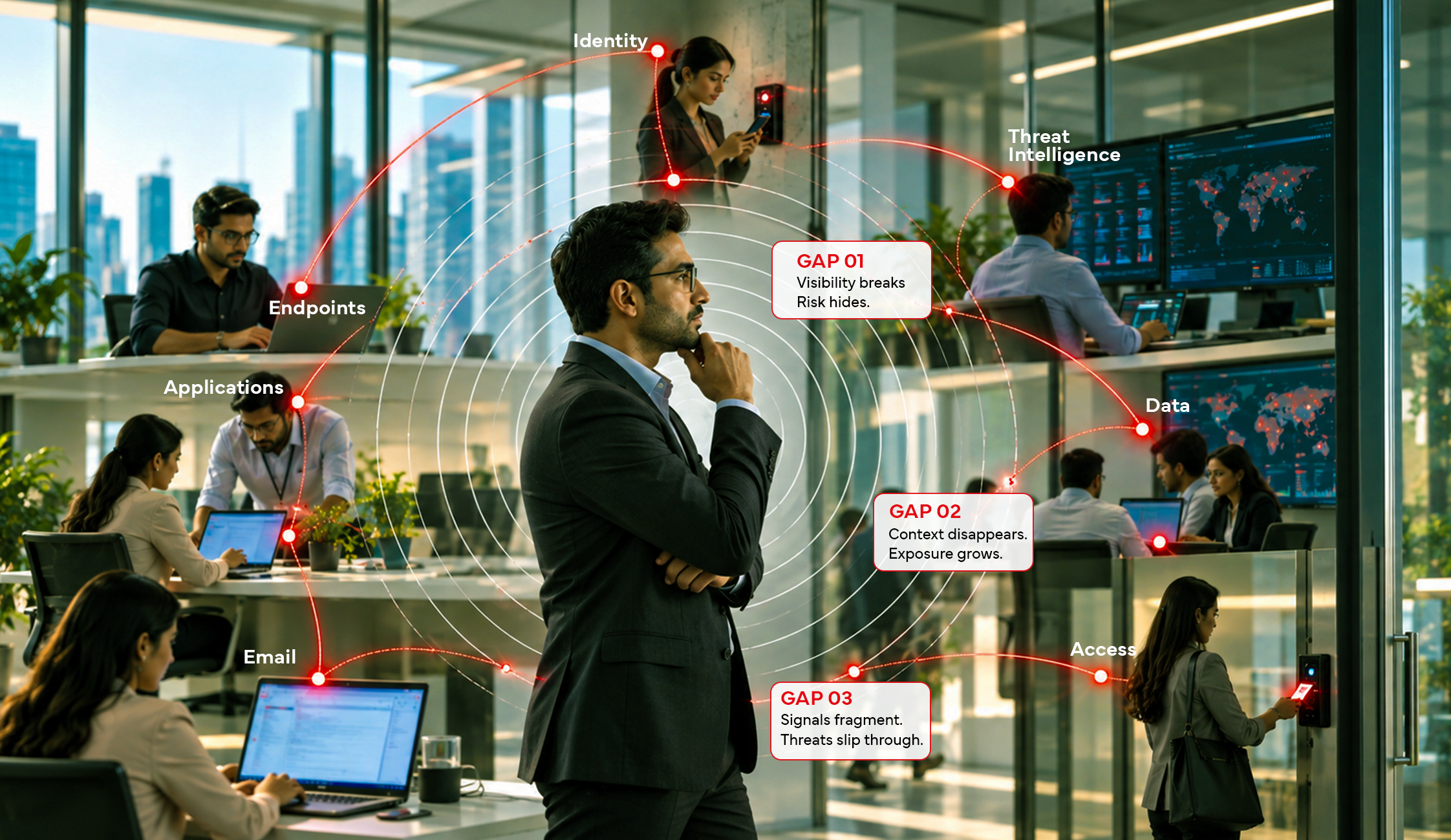
Today, security teams have more technology at their disposal than at any time in the last decade. To strengthen their workforce environments, companies have invested in endpoint protection, identity management, email security, access controls, cloud security, monitoring platforms, and threat intelligence systems. But even with this increased investment, many organisations struggle with visibility, coordination and operational control.
The problem is not the number of tools. Mature organisations will be multi-platform by default as workforce environments get more distributed and technology ecosystems get more specialised. The problem is that when these systems are siloed, they create valuable information but only part of the picture of workforce risk. In many organisations, security is becoming ever more fragmented at the very moment when it needs to be more coordinated.



Operating Models Have Not Kept Pace with the Evolution of Security Environments
Today’s workforce is working across locations, devices, applications and cloud environments that would have been hard to imagine only a few years ago. Employees travel between home and office networks. Business apps are distributed on multiple cloud platforms. Access decisions are increasingly about identities rather than physical locations.
As organisations have had to adjust to this new operating reality, security capabilities have developed in tandem. New controls have been introduced to meet new requirements. The introduction of monitoring tools improves visibility. Other platforms have been deployed to reduce emerging risks.
Each of these investments delivers a specific security benefit. However, security operating models haven’t always kept up with these changes. Many organisations now operate environments in which visibility across multiple systems is limited, decision-making is done in separate workflows, and security teams spend more and more time trying to connect information that was never designed to work together.
The result is not necessarily weaker security controls. It is greater operational complexity.
Fragmentation Creates Risk Not Within Systems But Between Them
Discussions about security often centre on the vulnerabilities of particular technologies. In practice, many of the hardest-to-identify risks take place between systems.
In an identity platform, a login event could look like a normal event. Endpoint activity can seem humdrum in device management tools. Access to applications in cloud environments may not be alerted. Each event, viewed in isolation, can look legitimate. The risk emerges when these signals are connected.
The trouble for security teams is that disconnected systems seldom provide that connected understanding. Information lives on separate platforms, requiring analysts to manually correlate events and switch between multiple consoles to build context.
This creates blind spots that are difficult to locate because they are not within a single technology environment. They are present in the relationships, dependencies and interactions of systems.
As the workforce environment becomes progressively interconnected, apprehending these relationships is becoming a key principle of modern security operations.
Greater Visibility Doesn’t Always Mean Greater Control
As complexity has increased, many organisations have added more monitoring capabilities. This can often lead to an increase in the amount of information security teams have access to, but not necessarily to greater understanding.
Greater visibility can sometimes mean greater operational noise.
Security operations centres are already dealing with large volumes of alerts and signals daily. Adding extra tools often means adding more notifications, dashboards and reports. Teams can quickly find themselves drowning in information rather than gaining meaningful insight.
Alert fatigue is an operational issue, not a technical one. Analysts spend time looking at events that may not represent meaningful risk. Security teams are increasingly relying on manual correlation and tribal knowledge to understand relationships between signals.
It’s not about collecting information anymore. There is already a lot of data in most organisations. The challenge is to make a connected understanding of what that information means.
Control cannot be generated solely by volume.
Unified Control Demands Connected Visibility and Context
The next evolution of workforce security is not to remove what has already been invested. Most organisations already have significant capabilities across their environments and will continue to operate across multiple technologies. The chance lies in unification.
Unified control brings visibility, context and decision-making together across the workforce ecosystem. Rather than managing each component in isolation, it provides organisations insight into how users, identities, devices, applications and access environments relate to each other.
This connected perspective changes how security operations work. Signals by themselves have no meaning, but in context they can. This enables more effective risk prioritisation.
Security teams spend less time collecting fractured information and more time understanding the operational implications, which accelerates decision-making. Unified control additionally enhances resilience. As the workforce changes, organisations can adapt security operations without adding complexity.
In this model, security investments are more valuable when they work in concert rather than in parallel.
Organisations Rethink Security in Terms of Coordination, Not Consolidation
More and more, there is recognition that workforce security does not have to translate to fewer technologies. It needs to be better coordinated between them.
Organisations are shifting from security models that favour siloed visibility to operating approaches that integrate information, streamline management, and create common understanding throughout environments.
This change is particularly timely, as digital transformation is gathering pace. With hybrid work, cloud adoption and distributed operating models, security teams now must understand more relationships.
Over time, this complexity becomes increasingly difficult to manage when systems are disconnected.
Unified control is an alternative operating model. It enables organisations to be agile while improving visibility, coordination and decision-making throughout workforce environments. The goal is not fewer technologies; it is less complexity between them.
From Disjointed Security to Centralised Management
This developing need for connected security operations is the foundation of Unified Control. It supports organisations moving from fragmented visibility and workflows to a broader holistic view of workforce risk.
The key is to offer visibility into users, devices, identities, applications, and access environments, providing a coordinated framework for greater insight across their existing security investments. It does not replace individual technologies but allows enterprises to connect information, enhance context, and simplify decision-making throughout workforce operations.
This helps shift from siloed security management to unified control, enabling organisations to decrease operational complexity while boosting resilience across increasingly distributed environments.
The future of workforce security depends on connection.
Today’s security environments are unlikely to become simpler. Workforce ecosystems will continue to grow, technologies will continue to change, and organisations will continue to adopt specialised capabilities to meet new needs. The challenge is not having multiple tools. Organisations will continue to operate across different environments while adopting specialised technologies to meet evolving needs. The challenge is the fragmentation between them.
Organisations that can connect their investments, understand the relationships between signals, and create unified control across increasingly complex environments are the future of workforce security. Security is most effective when visibility, context and judgements operate in concert.
In today’s workforce environments, control isn’t about seeing more. It’s about understanding more by bringing the right signals, context and decisions together