| Overview: OLED and QLED are two leading TV technologies offering remarkable picture quality, but they differ in performance, pricing, and display technology. This blog helps you compare their key differences and benefits so you can make an informed decision based on viewing preferences, room setup, and budget. |
Choosing Between OLED and QLED: Clarity Beyond the Screen
TVs have become more than just a source of entertainment—they’re immersive visual experiences. India’s smart TV market has grown over 28% YoY in 2024, with OLED and QLED TVs leading premium choices. While OLED offers self-lit pixels, QLED uses a quantum dot filter with an LED backlight.
Both technologies provide 4K or higher resolutions but differ significantly in contrast, brightness, durability, and pricing. Understanding these differences is crucial before investing in your next television, especially for buyers planning high-end purchases via EMI options like Insta EMI cards.
What is OLED?
OLED (Organic Light Emitting Diode) is a display technology where each pixel emits its own light. This means:
- True black levels: Pixels turn off entirely for perfect blacks.
- Ultra-thin designs: No need for a backlight.
- Superior contrast ratios: Great for dark-room viewing.
- Wider viewing angles: Colours stay accurate from all sides.
Drawbacks:
- Potential risk of burn-in with static images.
- Generally more expensive than QLED.
- Lower peak brightness compared to QLED, which might impact daylight viewing.
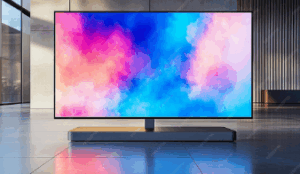
If you’re into immersive visuals and cinema at home, OLED might be your go-to.
What is QLED?
QLED (Quantum-dot Light Emitting Diode), used by brands like Samsung, uses an LED backlight and a quantum dot layer to improve colour and brightness.
- High peak brightness: Great for well-lit rooms.
- Brilliant colour reproduction: Thanks to quantum dots.
- Longer life span: Lower burn-in risk.
- Generally more affordable: Compared to OLED TVs.
Drawbacks:
- Blacks aren’t as deep as OLED.
- Slight loss of colour accuracy at extreme angles.
- Bulkier designs due to backlighting.
| Important to Know: OLED offers cinematic blacks, while QLED excels in brightness and vibrant colors—choose as per your room lighting. |
OLED Vs QLED: Key Differences at a Glance
Here’s a quick side-by-side comparison to help you decide which TV technology fits your lifestyle better.
| Feature | OLED | QLED |
| Light Source | Self-emissive (individual pixels) | Backlit with quantum dot layer |
| Black Levels | Perfect blacks | Deep but not perfect |
| Brightness | Lower peak brightness | Very high brightness |
| Viewing Angles | Excellent | Moderate to good |
| Thickness | Ultra-thin | Thicker due to backlight |
| Burn-in Risk | Possible (with static images) | Minimal |
| Price Range | Premium | Moderate to premium |
| Lifespan | Shorter (theoretically) | Longer |
Need to set up a home workstation that doubles as your media hub? Your TV choice matters.
Which is Better for You?
Your ideal choice depends on personal viewing needs:
- Choose OLED if:
- You mostly watch movies in dark environments.
- You want the most immersive visuals with deep blacks.
- Budget isn’t a major concern.
- Choose QLED if:
- You watch TV in bright rooms.
- You prefer sports or colourful visuals.
- You want a reliable, long-lasting panel with less worry about screen burn.
| Mistakes to Avoid: Avoid buying OLED for rooms with strong daylight unless it’s a top-tier model with anti-glare tech. |
How Insta EMI Cards Make Premium TV Shopping Affordable
Buying a high-end OLED or QLED TV can cost between ₹60,000 and ₹2,00,000. That’s where the Airtel Bajaj Finserv Insta EMI Card steps in:
Benefits:
- Pre-qualified loan offer amount of up to ₹3,00,000
- Zero down payment* offers on select models
- Available at 1.5+ lakh partner stores
- Flexible repayment from 3 to 60 months
- 100% digital process via Airtel Thanks app
Eligibility:
- Indian citizen, aged 21 to 65
- Steady source of income
- Basic KYC: Aadhaar, PAN, bank details
Also, great for buying kitchen appliances and other home electronics.
Price Comparison: OLED vs QLED TVs in India (2025)
Check out the typical price ranges for OLED and QLED TVs across popular sizes available in India.
| TV Size (inches) | OLED Price Range | QLED Price Range |
| 43″ | ₹65,000 – ₹90,000 | ₹40,000 – ₹70,000 |
| 55″ | ₹90,000 – ₹1,50,000 | ₹60,000 – ₹1,00,000 |
| 65″ | ₹1,40,000 – ₹2,25,000 | ₹85,000 – ₹1,60,000 |
Prices may vary by brand, resolution, and sales offers.
| Facts to Know: Most top-tier OLED and QLED TVs now come with AI picture processors and 120Hz refresh rates. Don’t forget to consider gaming compatibility if you’re a console user. |
Final Verdict: Your Perfect TV Awaits
Whether you choose OLED or QLED depends on your usage, lighting conditions, and preferences for contrast or brightness. OLED excels in dark environments with unmatched black levels, while QLED suits bright rooms with its vivid colours and luminosity. Regardless of your pick, you don’t need to compromise due to budget limitations.
The Airtel Bajaj Finserv Insta EMI Card offers a smart way to afford premium TVs through easy EMIs, zero down payment, and up to ₹3,00,000 pre-qualified loan offer amount. Apply now and bring home cinematic brilliance without financial strain.
FAQs
Which TV type is better for dark rooms?
OLED is ideal for dark rooms due to perfect blacks and superior contrast levels.
Are QLED TVs good for bright environments?
Yes, QLED TVs offer higher brightness levels, making them suitable for brightly lit rooms.
Do OLED TVs suffer from burn-in issues?
Yes, prolonged static images can cause burn-in on OLED screens over time.
Which TV has better viewing angles?
OLED offers excellent viewing angles with minimal colour and contrast loss from the sides.
Are QLED TVs more affordable than OLED TVs?
Generally, yes. QLED TVs are priced lower than OLED for similar screen sizes.