Share
ShareSOC vs SOC as a Service: Which Cybersecurity Model Actually Fits Your Business?
-
 April 12, 2026
 -

 8 min read
SOC vs SOC as a Service: Which Cybersecurity Model Actually Fits Your Business?
Cyberattacks are growing more targeted, and Indian enterprises face a tough call: build an in-house Security Operations Centre or outsource to a third-party provider? Both paths promise 24/7 threat monitoring, but they differ sharply on cost, control, deployment speed, and talent access. This guide breaks down every practical difference between a traditional SOC and SOC as a Service (SOCaaS), helping CXOs, IT managers, and network architects pick the model that matches their budget, risk profile, and growth plans.
A mid-sized enterprise spends upwards of $700,000 a year to keep an in-house Security Operations Centre running, before it even detects a single threat. Meanwhile, there’s a global shortage of 3.5 million cybersecurity professionals. These two facts alone explain why SOC as a service has gone from a niche offering to a mainstream strategy.



But does outsourcing your security operations always make sense? Not necessarily. This article walks you through what SOC is in both its traditional and as-a-service forms, comparing costs, control, expertise, scalability, and hybrid models so that you can make a grounded decision.
What Is SOC, and What Does It Actually Do?
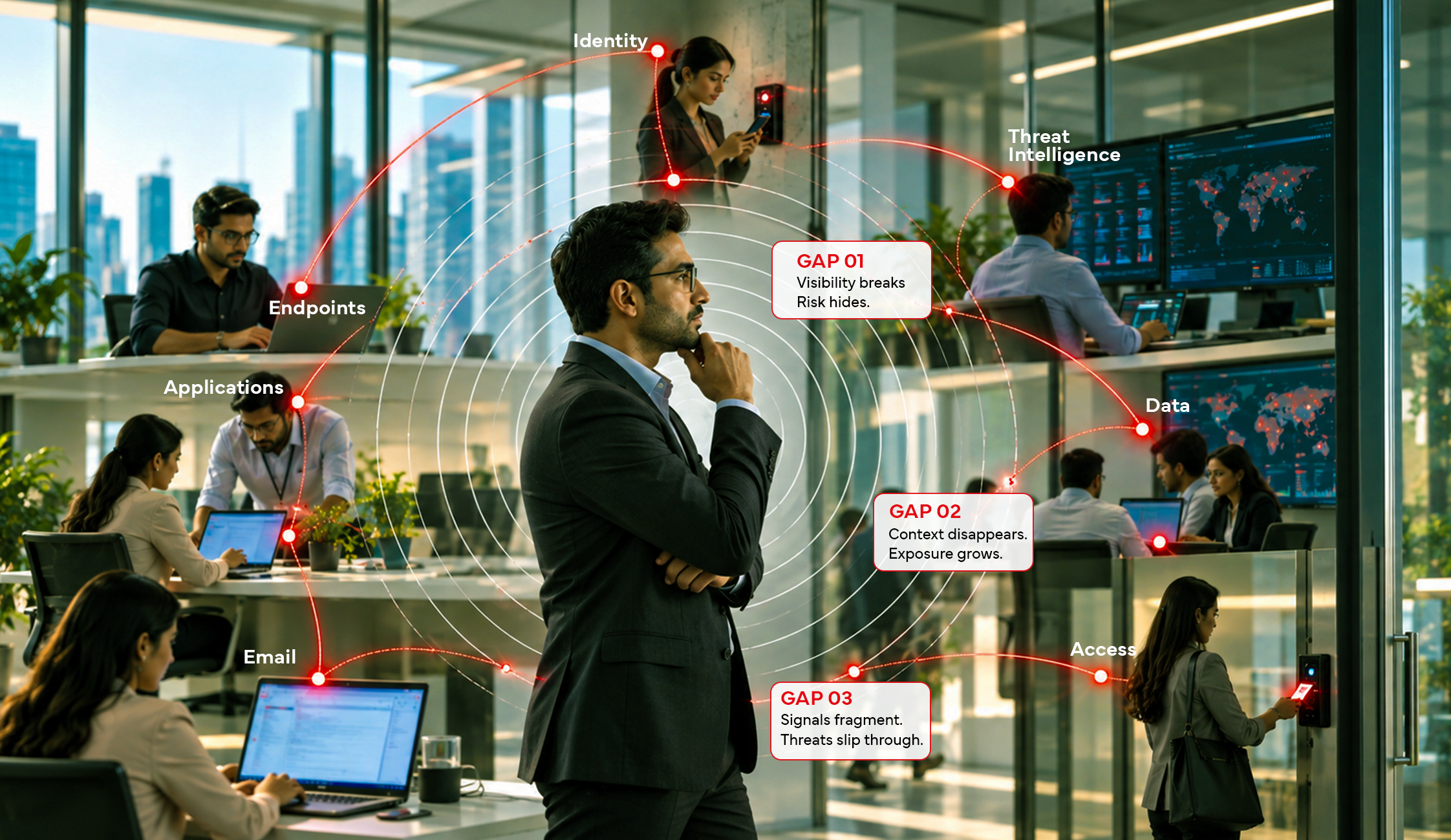
What is SOC in plain terms? A Security Operations Centre is a dedicated team of cybersecurity professionals working with defined processes and specialised tools that monitors your entire IT environment around the clock. Think of it as a control room for your digital infrastructure: servers, databases, endpoints, applications, networks, and cloud workloads all come under its watch.
Core Functions
A traditional SOC handles a wide range of responsibilities:
-
Continuous monitoring of security events across on-premises and cloud environments
-
Threat detection using tools like SIEM (Security Information and Event Management), IDS/IPS, and firewalls
-
Incident response — identifying, containing, and remediating breaches
-
Log management — collecting and analysing event data from firewalls, antivirus software, and user activity logs
-
Compliance reporting for standards like PCI-DSS, HIPAA, GDPR, and NIST
-
Root cause analysis after incidents, plus ongoing security refinement
The Three Pillars
Every SOC rests on three pillars: people (security analysts, incident responders), processes (response playbooks, escalation protocols), and technology (SIEM, SOAR, XDR platforms). Remove any one of these, and the SOC breaks down.
Understanding what SOC is at this structural level matters because it exposes the real challenge: assembling and retaining all three pillars in-house costs serious money and time.
How Does SOC as a Service Work Differently?
SOC as a service (SOCaaS) is a subscription-based, cloud-delivered model where a third-party provider runs your Security Operations Centre on your behalf. The provider handles staffing, tool management, threat intelligence, 24/7 monitoring, incident response, and compliance reporting, all delivered remotely.
What’s Included?
A typical SOC as a service package covers:
-
24/7 threat monitoring across your internet traffic, corporate networks, endpoints, servers, cloud infrastructure, and applications
-
Managed SIEM — the provider operates and maintains your SIEM platform
-
Expert analysts specialising in cloud security, malware analysis, identity management, and incident response
-
Threat intelligence feeds, updated continuously across hundreds of client environments
-
Vulnerability management and compliance reporting
Why It’s Gaining Ground
The numbers tell a clear story. According to a Kaspersky study, only 9% of organisations now plan to build their SOC entirely in-house. Over 26% are ready to fully adopt a SOC as a service model, and 64% plan to outsource at least part of their SOC operations.
The leading reason? It’s not cost savings (only 37% cited budgets). The top motivator is 24/7 protection (55%), followed by reducing workload on internal teams (47%) and access to advanced technologies (42%).
SOC vs SOC as a Service: A Head-to-Head Comparison
Here’s where the rubber meets the road. Let’s compare the two models across the dimensions that matter most to Indian enterprises.
Cost Structures
|
Parameter |
In-House SOC |
SOC as a Service |
|---|---|---|
|
Annual cost (mid-sized firm) |
$700K–$2 million |
50–70% lower than in-house |
|
Cost model |
Capital + operational expenditure |
Predictable subscription (monthly/annual) |
|
Hardware investment |
Required (SIEM, firewalls, servers) |
None — provider manages infrastructure |
|
ROI timeline |
18–24 months (estimated) |
6–12 months through reduced breach costs |
One estimate puts the savings even higher: SOC as a service can deliver equivalent or better protection at up to 85% less cost than an in-house setup. That’s a hard number to ignore, especially for growing Indian firms watching their IT budgets.
Deployment Speed
Building a SOC from scratch takes months. You need to hire analysts (tough, given the talent shortage), procure and integrate tools, build playbooks, and test everything. Fast-growing companies simply cannot afford that delay.
With SOC as a service, you get pre-built playbooks, pre-integrated tools, and an already-staffed team. Deployment happens in weeks, not quarters.
Talent and Expertise
This is perhaps the sharpest difference. SOCaaS providers employ specialists across cloud security, malware analysis, and incident response: skills that would take years to develop internally. Because these providers monitor threats across hundreds of client environments simultaneously, they spot attack patterns faster. When a new exploit appears, their analysts have likely already encountered and neutralised similar techniques elsewhere.
For an in-house team, the recruiter’s challenge is constant. The skills needed to run a SOC are scarce, and retention is a perpetual headache.
Control and Customisation
Here’s where the in-house SOC wins. You get full freedom over tool selection, workflows, detection rules, and response processes. Everything can be customised to your specific environment and compliance needs.
SOC as a service providers often work within predefined service tiers, which can limit niche customisation. However, they compensate by keeping threat intelligence current and adapting security measures across client environments faster than most in-house teams can update their own systems.
Scalability
Scaling an in-house SOC means more hiring, more hardware, more licensing. For small and medium businesses, this is often financially impractical.
SOCaaS providers offer tiered services. You scale up during growth phases, add advanced capabilities as add-ons, and scale down when needed. This elastic model suits high-growth Indian firms particularly well.
Which Model Should Your Organisation Choose?
There’s no universal answer. But the data points to a clear direction.
When In-House Makes Sense
-
You operate in a highly regulated industry (defence, government) requiring direct control over all security data
-
Your organisation has the budget for $1–2 million annually and can attract top cybersecurity talent
-
You need deeply customised detection rules tied to proprietary systems
When SOCaaS Fits Better
-
You need 24/7 monitoring, but can’t staff a full three-shift team
-
Your cybersecurity budget is limited, and you want predictable costs
-
You’re growing fast and need security that scales without long procurement cycles
-
You lack in-house expertise in areas like SIEM management, threat hunting, or compliance reporting
Selecting between SOC and SOC as a Service
The choice between an in-house SOC and SOC as a service comes down to three variables: your budget, your talent pipeline, and how much operational control you truly need. For most Indian enterprises, especially those scaling rapidly or operating with lean IT teams, a hybrid or fully outsourced model delivers stronger protection at a fraction of the cost.
Airtel Secure iSOC helps you create your cybersecurity infrastructure with managed security services, backed by a dedicated SOC with 350+ certified professionals and a zero-trust architecture: worth evaluating if you’re building or upgrading your security operations.
FAQs
1. What is SOC in cybersecurity?
A SOC is a centralised team using defined processes and tools like SIEM and SOAR to monitor, detect, and respond to security threats 24/7. It covers endpoints, networks, servers, and cloud workloads. Organisations can run it in-house or outsource it.
2. How much does an in-house SOC cost per year?
A functional in-house SOC costs between $700,000 and $2 million annually for mid-sized enterprises, including staffing, tools, and infrastructure. SOCaaS alternatives typically reduce this by 50–70%. Evaluate the total cost of ownership before committing.
3. What is the difference between SOC and SOC as a service?
An in-house SOC is built and operated internally with dedicated staff and infrastructure. SOC as a service is outsourced to a third-party provider on a subscription basis via the cloud. The main trade-off is control versus cost and speed.
4. Can SOC as a service handle compliance reporting?
Yes. Most SOCaaS providers generate compliance reports for standards like PCI-DSS, HIPAA, GDPR, and NIST. This is cited by 41% of organisations as a key reason for outsourcing. Confirm specific regulatory coverage before signing a contract.
5. What is a hybrid SOC model?
A hybrid SOC splits responsibilities between an in-house team and an external provider. About 63% of enterprises prefer this approach. It balances cost, control, and expertise. Internal teams handle core tasks while the provider covers off-hours and specialised functions.