| Overview: India’s move towards digital identity has reshaped financial access. While both e-Aadhaar and physical Aadhaar serve as valid identification, their utility varies across digital and traditional platforms. This blog explores their roles in India’s growing digital finance ecosystem and which version offers better convenience and security in online financial transactions. |
e-Aadhaar vs Physical Aadhaar: The Future of Digital Identity in Finance
India’s shift towards a cashless, connected economy has made identity verification central to every financial step. From opening a bank account to getting a personal loan approved, Aadhaar is now the cornerstone of digital finance. The arrival of e-Aadhaar has transformed this process, making it instant, paperless, and secure. With just a few clicks, users can verify their identity and access credit digitally, without physical documents.
Yet, the traditional physical Aadhaar card continues to play its part in offline and semi-digital settings, creating a balance between accessibility, technology, and trust in India’s financial ecosystem.
What is e-Aadhaar and How It Differs from Physical Aadhaar
As digital finance reshapes how Indians access money and services, both e-Aadhaar and physical Aadhaar verify identity, but their convenience, speed, and security set them apart.
| Feature | e-Aadhaar | Physical Aadhaar |
| Format | Digitally signed PDF | PVC or paper card |
| Accessibility | Downloadable anytime from UIDAI | Must be carried physically |
| Verification | Encrypted QR code, e-signature | QR code for offline use |
| Security | Password-protected | Prone to wear and misuse |
| Usability | Ideal for online KYC and digital loans | Useful for in-person verifications |
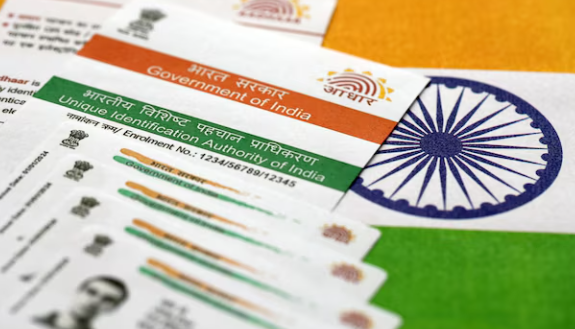
e-Aadhaar functions as an official digital identity document issued by UIDAI. It’s password-protected and digitally signed, ensuring authenticity during e-KYC. On the other hand, physical Aadhaar suits traditional scenarios like in-person verifications at banks or government offices.
| Facts to Know: UIDAI confirms that both e-Aadhaar and physical Aadhaar hold equal legal validity under the Aadhaar Act. |
Role of e-Aadhaar in Digital Finance
e-Aadhaar has simplified access to financial services in India’s growing digital economy. With a secure digital signature and quick verification capability, it enables faster onboarding in financial apps, online banking, and instant personal loans.
Key uses include:
- e-KYC for digital loans and insurance
- Online verification for mobile wallets and UPI apps
- Instant access for services requiring Aadhaar authentication
In personal loan applications, e-Aadhaar significantly reduces time and paperwork. For instance, Airtel Finance Personal Loan leverages e-Aadhaar for seamless KYC, allowing borrowers to complete the entire process digitally within minutes.
Physical Aadhaar: Still Relevant in Many Situations
While digital convenience dominates, physical Aadhaar remains useful in semi-digital or rural areas where connectivity is limited. It serves as tangible proof of identity and is still requested in:
- In-person bank verifications
- Rural banking services
- Government subsidy schemes
Despite its limitations, many still prefer physical Aadhaar for face-to-face verification, especially in areas where digital literacy is evolving.
| Important to Know: Carrying physical Aadhaar isn’t mandatory if you have access to your e-Aadhaar file via smartphone. |
e-Aadhaar Vs Physical Aadhaar in Personal Loan Applications
When it comes to applying for personal loans, the choice between e-Aadhaar and physical Aadhaar can significantly impact the speed, convenience, and overall experience of the borrowing process.
| Criteria | e-Aadhaar | Physical Aadhaar |
| Speed | Instant online verification | Manual verification takes longer |
| Documentation | Paperless process | Physical submission required |
| Fraud Risk | Low (digital encryption) | Higher (can be misplaced) |
| Integration | Compatible with fintech platforms | Limited to offline use |
When applying for a personal loan online, e-Aadhaar simplifies digital KYC and minimises manual errors. Platforms such as Airtel Finance Personal Loan allow users to upload their e-Aadhaar to complete applications within minutes.
| Mistakes to Avoid: Never share your Aadhaar OTP or password via email or social media. |
Security and Privacy in the Digital Era
The e-Aadhaar PDF is encrypted and password-protected, reducing the risk of identity misuse. UIDAI’s secure servers and QR code verification strengthen its trustworthiness. Conversely, physical Aadhaar is vulnerable to physical loss or duplication. Digital verification using e-Aadhaar enhances transparency in financial systems and aligns with India’s vision for a cashless economy.
If you’re managing multiple debts, explore these debt management tips or learn about loan refinancing options to stay financially secure.
| What You Must Know: e-Aadhaar can be downloaded anytime from the UIDAI portal using your registered mobile number. |
e-Aadhaar Paving the Way for Smarter Digital Finance
Both e-Aadhaar and physical Aadhaar are valid, but e-Aadhaar clearly leads in convenience, security, and speed for digital finance. As India moves towards paperless financial systems, e-Aadhaar’s role becomes more central, especially for services like online loans.
If you’re planning to take a personal loan, Airtel Finance Personal Loan offers a quick, fully digital process powered by Aadhaar-based verification, ensuring instant approval and minimal paperwork.
FAQs
1. Is e-Aadhaar legally valid like the physical Aadhaar card?
Yes, e-Aadhaar holds the same legal status as the physical Aadhaar under the Aadhaar Act, 2016, issued by UIDAI.
2. Can e-Aadhaar be used for online financial transactions?
Absolutely. e-Aadhaar enables secure, real-time identity verification for digital finance, e-KYC, and instant loan or banking applications.
3. How secure is e-Aadhaar compared to the physical Aadhaar?
e-Aadhaar is digitally signed, password-protected, and encrypted, offering stronger protection against misuse than the physical Aadhaar card.
4. Where can physical Aadhaar still be useful?
Physical Aadhaar remains useful for offline verifications, especially in rural areas or where digital access is limited or unavailable.
5. Can e-Aadhaar be downloaded anytime?
Yes, it can be downloaded anytime from the UIDAI website using your registered mobile number and Aadhaar credentials.