Share
ShareWhy IPL Is the Backbone of International Internet Services for Cross-Border Businesses
-
 July 30, 2026
 -

 7 min read

Multinational companies face a persistent headache: moving sensitive data between offices in different countries without packet loss, latency spikes, or security gaps. For IT managers and CXOs evaluating reliable cross-border connectivity, this article breaks down how IPLs in telecom works, why it outperforms public internet for global operations, which industries depend on it most, and what to consider when choosing international internet services for your organisation.
When a trading desk in Mumbai needs to sync with a clearing house in London within milliseconds, a shared internet connection simply won’t cut it. That split-second delay, or worse, a dropped packet, can mean lakhs lost on a single transaction. This is precisely where IPL steps in.



An IPL in telecom refers to a dedicated, point-to-point private circuit connecting two locations in different countries. Unlike regular broadband, this line belongs exclusively to your organisation. In this article, we’ll walk through how IPL functions technically, why the public internet fails multinational firms, which sectors rely on it most, and how it compares against alternatives like MPLS and VPN.
What Is IPLC and How Does It Actually Work?
An IPLC, International Private Leased Circuit, is a private telecom line leased from a service provider that directly connects two endpoints in separate countries. Only your organisation’s data travels on it. No sharing. No congestion from other users.
Three Core Components
Every IPL circuit is built on three pillars:
-
Physical infrastructure: Undersea fibre-optic cables or terrestrial landlines forming the actual data path. More than 97% of the world’s internet and data traffic travels through submarine fibre-optic cables; your IPLC rides on these same physical routes, but on a reserved lane.
-
Point-to-point design: A direct connection between two designated endpoints, ensuring predictable data flow without routing through multiple public nodes.
-
Guaranteed bandwidth: The entire capacity of the circuit is reserved for the leasing organisation. Nobody else touches it.
Bandwidth and Network Layer Flexibility
IPL services can operate at Layer 1, Layer 2, or Layer 3, depending on your enterprise’s architecture requirements. Bandwidth options range from 2 Mbps all the way up to 10 Gbps and even 100 Gbps. Some providers offer scalability from 2 Mbps to multiple Tbps, so you can start small and expand as your data demands grow.
According to WiseGuy Reports, the global IPL market is projected to reach USD 25.8 billion by 2032, growing at 5.11% annually from 2024 to 2032. That steady climb tells you one thing clearly: enterprises and telcos still bank on IPL in telecom for their international communication needs.
Why Public Internet Falls Short for Cross-Border Business Operations
Here’s the blunt truth: public internet connections introduce unpredictable latency, packet loss, and security risks. For a company running ERP systems between Singapore and London, or syncing transaction databases between continents, these aren’t minor annoyances; they’re operational risks.
The Dedicated Bandwidth Advantage
With international internet services built on public infrastructure, your data competes with millions of other users. During peak hours, bandwidth gets squeezed. With IPL, bandwidth isn’t shared. Performance stays consistent regardless of what’s happening elsewhere on the network.
Providers back IPL circuits with SLAs that typically guarantee 99.9% or higher availability. That’s less than 8.76 hours of downtime per year.
Security Without the Public Internet’s Exposure
Since an IPL connection never touches the public internet, your data isn’t exposed to DDoS attacks, man-in-the-middle interception, or unauthorised access. Only the two authorised endpoints can communicate over the circuit. For financial institutions handling classified transaction data or government bodies transmitting sensitive records, this isolation is non-negotiable.
Predictable Latency for Time-Sensitive Applications
On a dedicated path, latency doesn’t fluctuate. This matters enormously for:
-
Algorithmic trading (where microseconds determine profit or loss)
-
Live video conferencing across time zones
-
Cloud-based ERP synchronisation between global offices
Think of it this way: public internet is a busy highway where your data sits in traffic alongside everyone else’s Netflix streams and social media uploads. An IPL is a private expressway, the same distance, but you’re the only vehicle on the road.
Which Industries Depend Most on IPL in Telecom?
Multiple sectors treat IPL in telecom as an infrastructure that they cannot operate without. Here’s a closer look:
Financial Services
Banks and trading firms need ultra-reliable, low-latency connections between trading venues, clearing houses, and internal systems. One documented case: a leading investment bank used IPL to connect trading desks across New York, London, and Hong Kong. The dedicated bandwidth allowed faster trade execution, while the private circuit kept sensitive financial data protected.
Healthcare
Hospitals and research institutions use IPL circuits to transmit medical records, imaging files, and research data between international facilities. This helps maintain compliance with privacy regulations like HIPAA and GDPR, where a data breach isn’t just costly; it’s potentially criminal.
Media and Broadcasting
Media companies transfer massive video and audio files across borders daily. A private circuit ensures uninterrupted delivery and protects content against piracy during transit.
Government and Defence
Classified information moving between international government entities demands the kind of isolation that only a dedicated circuit provides. International internet services over public networks simply carry too much risk for these applications.
|
Industry |
Primary Use Case |
Why IPL Works |
|---|---|---|
|
Financial Services |
Trading desk connectivity, transaction sync |
Deterministic low latency, data isolation |
|
Healthcare |
Medical records, imaging file transfers |
Regulatory compliance (HIPAA, GDPR) |
|
Media |
Large file transfers, content distribution |
High bandwidth, piracy protection |
|
Government |
Classified communications |
Complete traffic isolation from public networks |
|
MNCs |
ERP, video conferencing, data sharing |
Consistent performance across continents |
How to Evaluate International Internet Services: IPL vs. Alternatives
Choosing the right cross-border connectivity solution depends on your use case, budget, and performance requirements. Here’s how IPL stacks up against the two most common alternatives:
IPL vs. MPLS
MPLS (Multiprotocol Label Switching) connects multiple sites through a provider’s shared infrastructure, supporting any-to-any connectivity. IPL is strictly point-to-point.
|
Parameter |
IPL |
MPLS |
|---|---|---|
|
Topology |
Point-to-point |
Any-to-any (mesh/hub-spoke) |
|
Bandwidth |
Dedicated, unshared |
Shared across the provider’s network |
|
Latency |
Lower and predictable |
Higher, variable |
|
Security |
Traffic fully isolated |
Traffic is segregated, but on shared infrastructure |
|
Best for |
Two-site connections needing guaranteed performance |
Multi-site networks need flexibility |
IPL typically delivers lower latency than MPLS and offers a more reliable connection because it doesn’t depend on shared infrastructure.
IPL vs. Internet VPN
An Internet VPN creates encrypted tunnels over the public Internet. It’s cheap and quick to deploy. But performance depends entirely on internet conditions outside your control; latency spikes, packet loss, and bandwidth contention are common. IPL eliminates these variables with a dedicated, SLA-protected path.
For organisations where connectivity directly impacts revenue (trading firms, global SaaS platforms, media houses), international internet services through a VPN simply carry too much risk.
What to Look for When Choosing a Provider
When evaluating IPL in telecom providers, prioritise these factors:
-
Route diversity: Can the provider offer at least three diverse paths per destination? This protects against single points of failure.
-
Submarine cable reach: Providers with investments in multiple subsea cable systems (like 2Africa, SMW6, SJC2) offer better resilience.
-
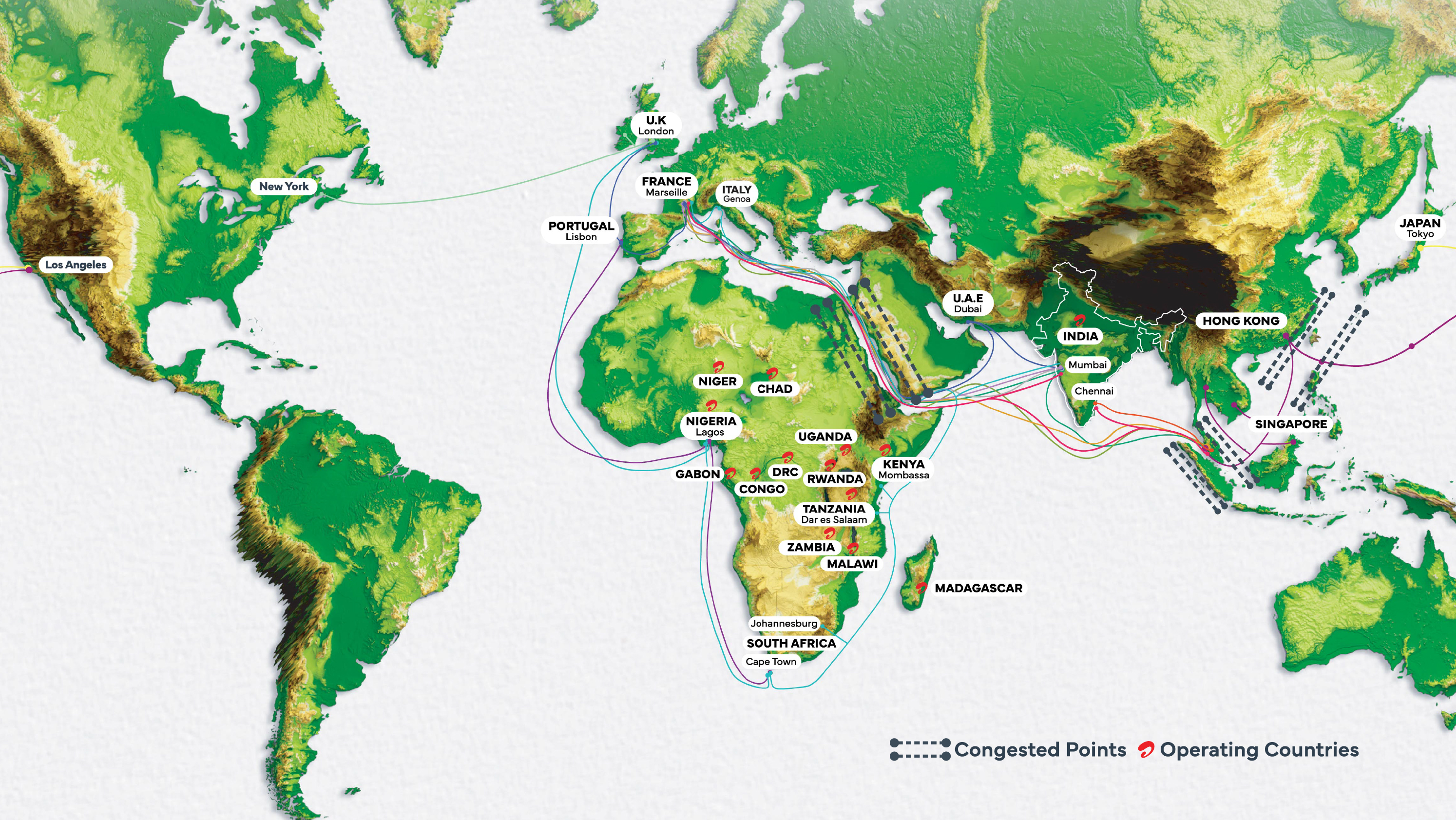
Choke point avoidance: Your provider should be able to bypass high-risk corridors like the Red Sea, South China Sea, and Malacca Strait.
-
SLA terms: Insist on documented uptime guarantees, latency commitments, and packet delivery metrics.
-
Scalability: Your circuit should scale from 2 Mbps to 10 Gbps+ without a complete infrastructure overhaul.
India’s geographic position in the Indian Ocean Region places it at the crossroads of major global data routes linking Europe, Southeast Asia, and the Middle East. Projects like 2Africa Pearls, India-Asia-Express, and India-Europe-Express submarine cable systems are further strengthening India’s role as a global connectivity hub, making international internet services from India-based providers increasingly competitive.
Boosting Business Operations with IPLs
For any business operating across borders, the choice of international connectivity directly shapes operational resilience, data security, and application performance. IPL in telecom remains the most reliable way to guarantee dedicated bandwidth, predictable latency, and complete traffic isolation between international sites. As cross-border data volumes grow, investing in the right IPL circuit isn’t optional; it’s a strategic necessity.
Airtel IPL solutions span 50+ countries across 5 continents, with 34+ submarine cable systems, a minimum of 3 diverse routes per destination, and the ability to bypass high-risk choke points, which is worth evaluating if your organisation needs dependable global connectivity.
FAQs
-
IPL is a dedicated private circuit connecting two locations in different countries, leased from a telecom provider. It offers guaranteed bandwidth, low latency, and SLAs typically guaranteeing 99.9%+ uptime. Businesses use it for secure cross-border data exchange.
-
IPL provides a dedicated point-to-point connection with unshared bandwidth, while MPLS uses shared provider infrastructure for multi-site connectivity. IPL delivers lower, more predictable latency. Choose based on whether you need two-site or multi-site networking.
-
Financial services, healthcare, media, government, and multinational corporations rely heavily on IPL. Banks use it for low-latency trading; hospitals use it for HIPAA-compliant medical data transfers. Any sector handling sensitive cross-border data benefits from dedicated circuits.
-
IPL circuits are available from 2 Mbps to 10 Gbps and 100 Gbps, with some providers offering scalability up to multiple Tbps. Common rates include 2 Mbps, 45 Mbps, 155 Mbps, 622 Mbps, and 2.5 Gbps. Choose based on your data volume requirements.
-
IPL traffic never touches the public internet, eliminating exposure to DDoS attacks, interception, and unauthorised access. VPNs encrypt data but still route it over shared public infrastructure. For regulated industries, IPL provides stronger data isolation and compliance assurance.