Share
ShareSubsea Cable Network Explained: The Backbone of Global Internet Connectivity
-
 February 8, 2026
 -

 6 min read
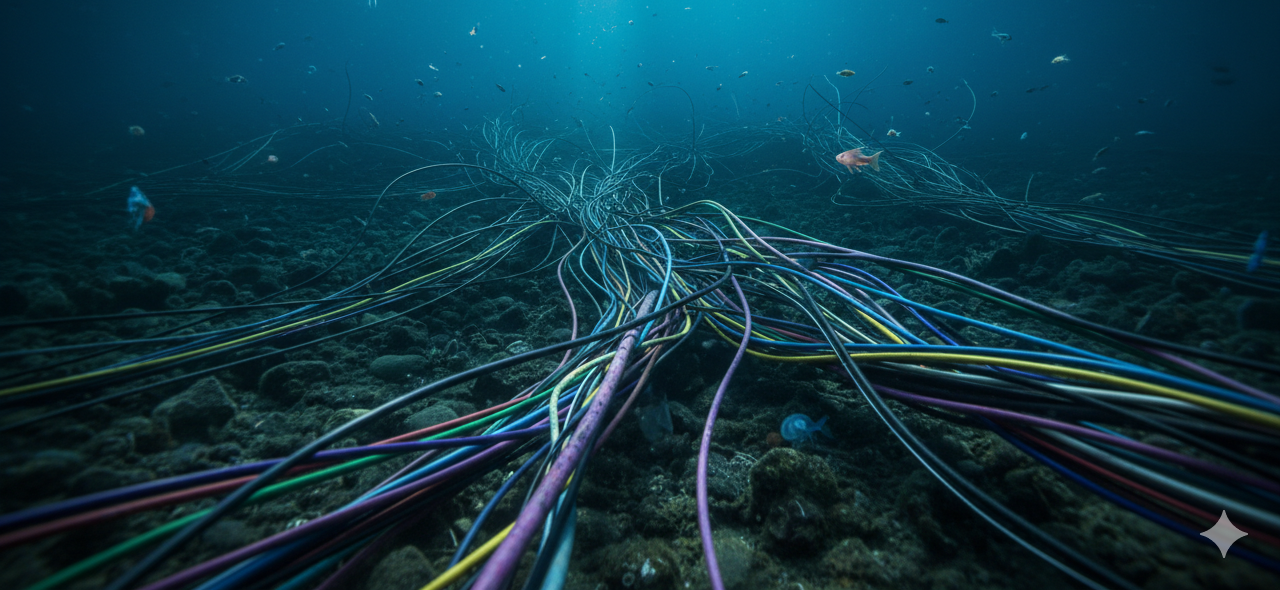
Every time you watch a Netflix show from a US server or join a video call with colleagues in Singapore, your data travels through fibre-optic cables lying 8,000 metres beneath the ocean. These subsea cable networks carry 99% of intercontinental internet traffic, not satellites, as many people assume. Currently, 600 active and planned submarine cables stretch across 1.4 million kilometres of ocean floor, connecting every continent except Antarctica. Without these underwater highways, your WhatsApp messages to overseas contacts would take minutes, not milliseconds.



Think of global fibre networks as the complete circulatory system of internet connectivity. While subsea cable networks form the arteries crossing oceans, terrestrial fibre-optic cables serve as the veins reaching inland cities and businesses. Together, they handle everything from ₹10 lakh international wire transfers to 4K video streams, processing data volumes that would fill millions of hard drives every second.
We’ll examine how these cables transmit data at light speed, why they matter for Indian businesses expanding globally, their vulnerabilities to both anchors and cyberattacks, and the technology upgrades coming in 2025.
What Makes a Subsea Cable Network Work: Core Components and Architecture
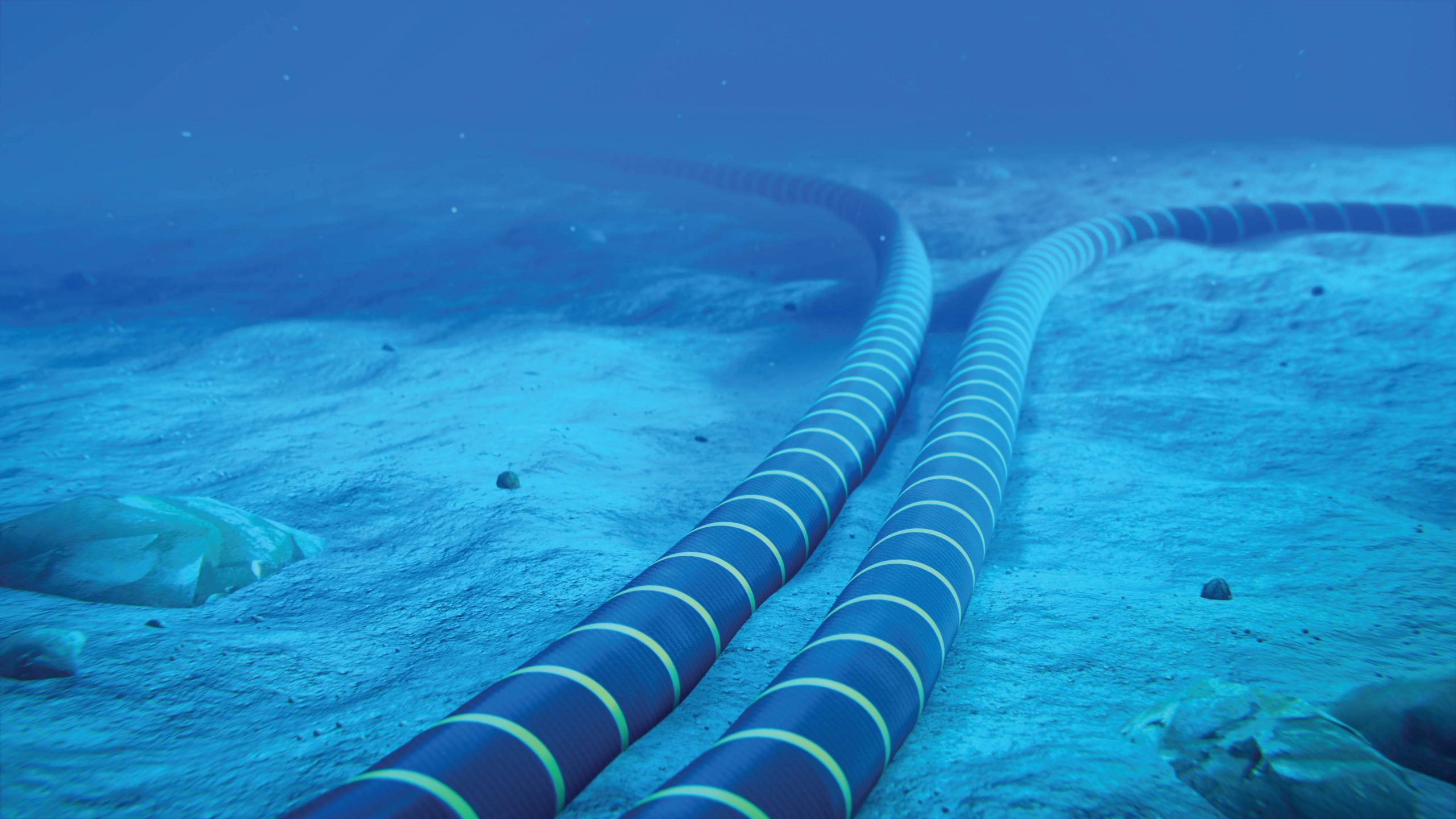
A subsea cable network consists of several critical parts working together. The cable itself measures just 2-3 cm thick, about the width of a garden hose, yet contains 4 to 24 fibre pairs protected by steel and polyethene armouring. Each fibre pair transmits laser pulses carrying your data at light speed across thousands of kilometres.
The Technology Behind 500 Tbps Capacity
Modern cables achieve mind-boggling speeds through Wavelength Division Multiplexing (WDM). This technology splits light into hundreds of different colours, with each colour carrying separate data streams. Picture a single fibre carrying 100 different TV channels simultaneously, except instead of TV shows, it’s transmitting:
-
200,000 HD video calls
-
50 million email messages
-
10 million webpage requests
-
All happening every second
The numbers get bigger with each generation. Older systems from 2010 manage hundreds of Gbps. New installations like Google’s Dunant cable push 250 Tbps, enough bandwidth to download 31,250 full-length movies per second. The upcoming 2Africa cable stretches 37,000 km with 180 Tbps capacity, connecting 33 countries across Africa, Europe, and Asia.
Cable Landing Stations: Where Ocean Meets Land
Cable landing stations (CLS) serve as the critical junction points where subsea cable networks connect to terrestrial infrastructure. These fortified coastal facilities house:
|
Component |
Function |
Specifications |
|---|---|---|
|
Branching Units |
Split signals to multiple destinations |
Handle up to 24 fibre pairs |
|
Power Feed Equipment |
Supply constant electricity to underwater repeaters |
10-15 kW per cable via high-voltage DC |
|
Signal Regenerators |
Boost weakened light signals |
Amplify every 50-100 km |
|
Monitoring Systems |
Track cable health and detect damage |
Distributed Acoustic Sensing (DAS) with 1 km resolution |
From these stations, data flows into global fibre networks through Dense Wavelength Division Multiplexing (DWDM) equipment. Indian businesses connecting to international markets rely on this seamless handoff between sea and land infrastructure.
Global Fibre Network Integration: Connecting Continents to Your Office
The global fibre network extends submarine cables inland through transcontinental links. When you access cloud services from AWS Mumbai or send files to European partners, your data follows this path:
-
Originates from your office internet connection
-
Routes through domestic fibre backbones
-
Reaches a cable landing station
-
Travels via subsea cable network to destination country
-
Enters foreign terrestrial networks
-
Arrives at the target server or office
India’s Strategic Position in Global Connectivity
India connects to the world through multiple submarine cables:
-
IMEWE (India-Middle East-Western Europe): 13,000 km linking Mumbai to France
-
SEA-ME-WE series: Connecting Chennai and Mumbai to Southeast Asia and Europe
-
Bharat-Lanka: Direct link to Sri Lanka
-
FALCON: Mumbai to Persian Gulf regions
These cables integrate with domestic DWDM networks operating at 100 Tbps speeds. The 2024 Red Sea cable cuts demonstrated why redundancy matters: when Houthi attacks severed cables carrying 25% of Europe-Asia traffic, Indian businesses experienced 100-millisecond latency increases until traffic was rerouted via Cape routes.
How Businesses Benefit from Direct Subsea Access
Companies with international operations see tangible advantages from global fibre network connectivity:
-
Financial Services: Stock trading firms shave 25 milliseconds off transaction times using express submarine routes. For high-frequency trading, every millisecond saved translates to ₹50,000-₹1,00,000 in potential gains per trade.
-
IT and Software: TCS, Infosys, and other Indian tech giants depend on subsea cable networks for delivering services to global clients. A single hour of cable outage costs these companies ₹1-10 crore in lost productivity and SLA penalties.
-
Manufacturing: Automotive companies coordinate with suppliers across continents through ERP systems requiring sub-100ms latency. Direct fibre routes ensure assembly lines stay synchronised with parts shipments.
Security Challenges Facing Subsea Cable Networks
Despite carrying 99% of international internet traffic, subsea cable networks face multiple security threats. Physical vulnerabilities and cyber risks require constant vigilance from operators and governments.
Physical Threats and Protection Measures
Annual cable damage statistics reveal surprising patterns:
-
100-200 cuts happen globally each year
-
70% result from fishing trawlers and ship anchors
-
20% come from earthquakes and underwater landslides
-
Less than 10% involve deliberate sabotage
The 2024 Tonga volcanic eruption showed nature’s power, cutting the island nation’s only cable and leaving 105,000 people without internet for days. Similarly, the 2022 Nord Stream pipeline incidents raised concerns about deliberate attacks on underwater infrastructure.
Protection strategies include:
-
Distributed Acoustic Sensing (DAS): Converts cables into underwater microphones detecting approaching vessels at 1 km distance. When fishing boats drift too close, operators receive alerts and contact maritime authorities.
-
Armoured Construction: Steel wire and polyethylene layers protect against shark bites (yes, sharks occasionally chew cables) and anchor strikes. Burial 1-2 metres under the seabed provides additional protection near shores.
-
Route Diversity: Major global fibre network operators maintain a minimum of three separate paths per destination. If one cable fails, traffic automatically reroutes in milliseconds.
Cybersecurity at Cable Landing Stations
Cable landing stations represent critical vulnerability points where subsea cable networks interface with terrestrial systems. The European Union Agency for Cybersecurity (ENISA) reported 10x increases in DDoS attacks targeting these facilities during 2024.
Security measures include:
-
End-to-end encryption using AES-256 standards
-
Zero-trust network architectures requiring authentication for all connections
-
Physical security with 24/7 monitoring and restricted access zones
-
Quantum-resistant cryptography rollouts planned by 2026
Indian enterprises must consider these security factors when selecting international connectivity providers. A single compromised cable landing station could expose sensitive business communications.
Making Strategic Connectivity Decisions for Your Business
Understanding subsea cable networks and global fibre networks helps businesses make informed connectivity choices. Consider these factors when evaluating international connectivity:
-
Latency requirements: Real-time applications need direct submarine routes. Email and file transfers tolerate indirect paths.
-
Redundancy needs: Mission-critical operations require multiple cable paths. Standard business traffic is managed with single routes.
-
Security priorities: Financial and healthcare data demands encrypted dedicated capacity. General web traffic uses shared infrastructure.
-
Budget constraints: Private capacity on new cables costs millions. Shared bandwidth offers enterprise-grade performance at a fraction of the price.
For organisations requiring robust international connectivity with comprehensive security, solutions that combine dedicated bandwidth with managed security services address both performance and protection needs. Airtel’s Global Connectivity Solutions integrates pan-India Internet Leased Lines with Zscaler’s security platform, providing zero-trust access and real-time DDoS protection through a dedicated Security Operations Centre staffed by 350+ certified professionals.