| Overview: Being unemployed doesn’t mean your credit journey ends. Learn how to make your CIBIL score better with 4 proven strategies: auditing credit reports, maintaining timely payments, managing credit utilisation smartly, and building positive credit through secured options. |
Your Credit Score Doesn’t Have to Suffer During Job Loss
Losing your job feels overwhelming, especially when you worry about how to make your CIBIL score better during unemployment. Here’s the reality: over 9.2% of India’s urban population faces unemployment, yet many don’t realise their credit scores can actually improve during this period with the right strategies.
Your CIBIL score reflects your credit behaviour, not just your employment status. Banks and NBFCs increasingly consider alternative income sources and credit history patterns. Even a 30-50 point improvement can reduce your future loan interest rates by 1-2%, potentially saving ₹18,000 on a ₹5 lakh personal loan over three years. Let’s explore four proven methods to strengthen your credit profile while job hunting.
Strategy 1: Audit and Correct Your Credit Report Immediately
The RBI mandates that every Indian can access one free credit report annually from each bureau—CIBIL, Equifax, Experian, and CRIF High Mark. Industry studies reveal up to 25% of Indian credit reports contain errors, from outdated loan information to incorrectly reported payment delays.
When you’re unemployed, these errors become costlier. A single incorrect “overdue” entry can drop your score by 50-100 points, making future loan approvals nearly impossible.
Step-by-Step Error Correction Process
- Download reports from all four bureaus – each may show different information.
- Compare account details carefully – check loan amounts, payment histories, and account statuses.
- Identify discrepancies – look for duplicate entries, closed accounts marked active, or wrong payment records.
- File online disputes – attach supporting documents like NOCs or payment receipts.
- Follow up within 30 days – RBI requires bureaus to resolve disputes in this timeframe.
| Pro Tip: Screenshot your current score before filing disputes. This helps track improvements once corrections are made. |
Strategy 2: Maintain Perfect Payment History with Strategic Planning
Payment history contributes 35% to your CIBIL score calculation. Missing even one EMI or credit card payment creates a “Days Past Due” entry that stays visible for 36 months, significantly impacting how to make your CIBIL score better.
During unemployment, this becomes challenging but not impossible. Here’s how successful credit builders manage it:
| Payment Strategy | Impact on Score | Implementation |
| Auto-debit minimum payments | Prevents negative marks | Set up for all credit accounts |
| Partial EMI payments | Maintains positive history | Pay at least 50% of due amount |
| Family support system | Ensures zero delays | Arrange temporary payment help |
Smart Payment Techniques During Income Gaps
- The Emergency Fund Approach: Maintain a separate account with 3-6 months of EMI payments. Even ₹30,000 can cover most credit obligations for 2-3 months.
- The Minimum Payment Strategy: For credit cards, always pay the minimum due (typically 5% of outstanding). While interest accumulates, your credit history remains clean.
- The Liquidation Method: Consider breaking small fixed deposits or selling non-essential assets to maintain payment schedules rather than damaging your credit permanently.
Strategy 3: Optimise Credit Utilisation Without Income
Understanding the 30% Utilisation Rule
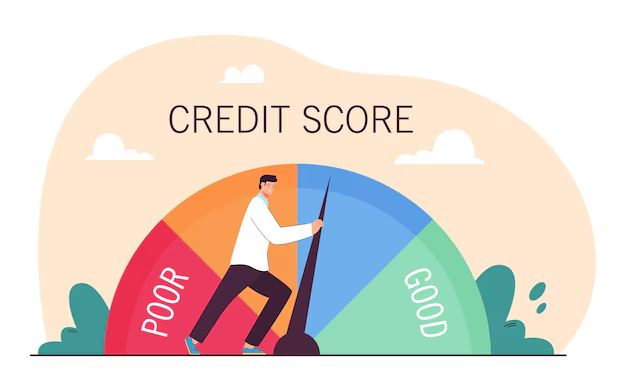
Credit utilisation ratio (amount used ÷ total available limit) should stay below 30%. Going above this threshold can reduce your score by 20-50 points monthly. Here’s the calculation:
If your credit card limit is ₹1,00,000 and you maintain ₹40,000 average balance:
- Current utilisation: 40% (too high)
- Target utilisation: <30% (₹30,000)
- Required reduction: ₹10,000
Proven Utilisation Reduction Techniques
- Request limit increases on existing cards – Many banks approve based on payment history, not current income.
- Make multiple payments monthly – Pay twice to reduce average monthly utilisation reported to bureaus.
- Keep old accounts active – Older cards contribute to total available credit, improving your ratio.
- Use EMI conversion strategically – Convert large purchases to EMIs to maintain low utilisation.
Implementing these strategies can significantly improve your credit utilisation, leading to a better credit score and access to more favorable financial products in the future.
Utilisation Impact Calculation
| Scenario | Card Limit | Balance | Utilisation | Score Impact |
| Before optimisation | ₹1,00,000 | ₹45,000 | 45% | -30 to -50 points |
| After limit increase | ₹1,50,000 | ₹45,000 | 30% | Neutral |
| After payment timing | ₹1,50,000 | ₹22,500 | 15% | +10 to +20 points |
Strategy 4: Build Positive Credit Through Secured Options
Secured credit cards require a fixed deposit (typically ₹10,000-₹50,000) as collateral but function like regular credit cards. Banks report your payment behaviour to credit bureaus, helping you build positive history even without income.
The Math Behind Secured Card Benefits:
- Deposit required: ₹25,000
- Credit limit received: ₹25,000
- Perfect payment record for 12 months: +60 to +80 CIBIL points
- Cost: Only the opportunity cost of FD interest (7-8% annually)
| Did You Know? Adding yourself as an authorised user on a family member’s well-maintained credit card can improve your credit history within 30-60 days, as their positive payment behaviour reflects on your report. |
Building Credit Score Comparison
| Method | Time to Impact | Score Improvement | Risk Level |
| Secured credit card | 6-12 months | 60-80 points | Low |
| Gold loan | 3-6 months | 40-60 points | Very low |
| Co-applicant loan | 1-3 months | 30-50 points | Medium |
| Authorised user | 1-2 months | 20-40 points | Very low |
Take Control of Your Credit Future Today
Understanding how to make your CIBIL score better during unemployment empowers you to emerge financially stronger when you find your next job. These four strategies—error correction, payment discipline, utilisation optimisation, and secured credit building—work synergistically to improve your score by 50-100 points within 6-12 months.
Remember, unemployment is temporary, but credit damage can last years. By implementing these proven strategies now, you’re investing in your financial future. Consider starting with a free credit score check with Airtel Finance to establish your baseline; then systematically apply these techniques. Your credit journey doesn’t pause during career transitions. Make it stronger instead.
FAQs
1. Can I get approved for loans while unemployed if I know how to make your CIBIL score better?
Yes, many lenders consider alternative income sources, co-applicants, or secured loan options. A strong CIBIL score above 750 significantly improves approval chances even without traditional employment.
2. How quickly can unemployed individuals see improvements in their CIBIL score?
Error corrections can reflect within 30 days, while consistent payment behaviour and utilisation management typically show results within 90-180 days of implementation.
3. Do secured credit cards really help build credit scores for unemployed people?
Absolutely. Secured cards function identically to regular cards for credit reporting purposes. Twelve months of perfect payments can increase scores by 60-80 points.
4. What’s the biggest mistake unemployed people make with their credit scores?
Completely stopping all credit activity and payments. Maintaining minimum payments and keeping accounts active is crucial for long-term credit health and score improvement.
5. Should unemployed individuals close credit cards to avoid annual fees?
Generally no. Closing cards reduces total available credit and average account age, both important scoring factors. Instead, negotiate fee waivers or downgrade to no-fee variants.