



Seamless, high-performance content delivery with 100% uptime SLA
Learn More Learn more about CDN





Keeping data in India is no longer enough. Enterprises are increasingly looking for greater control across infrastructure, operations and governance without taking on the cost and complexity of building and managing cloud environments themselves. At the same time, AI and data-intensive workloads are driving up compute, VRAM and DRAM requirements, making infrastructure economics harder to justify. This is accelerating the shift toward sovereign cloud models that balance control, performance and scalability across different industries




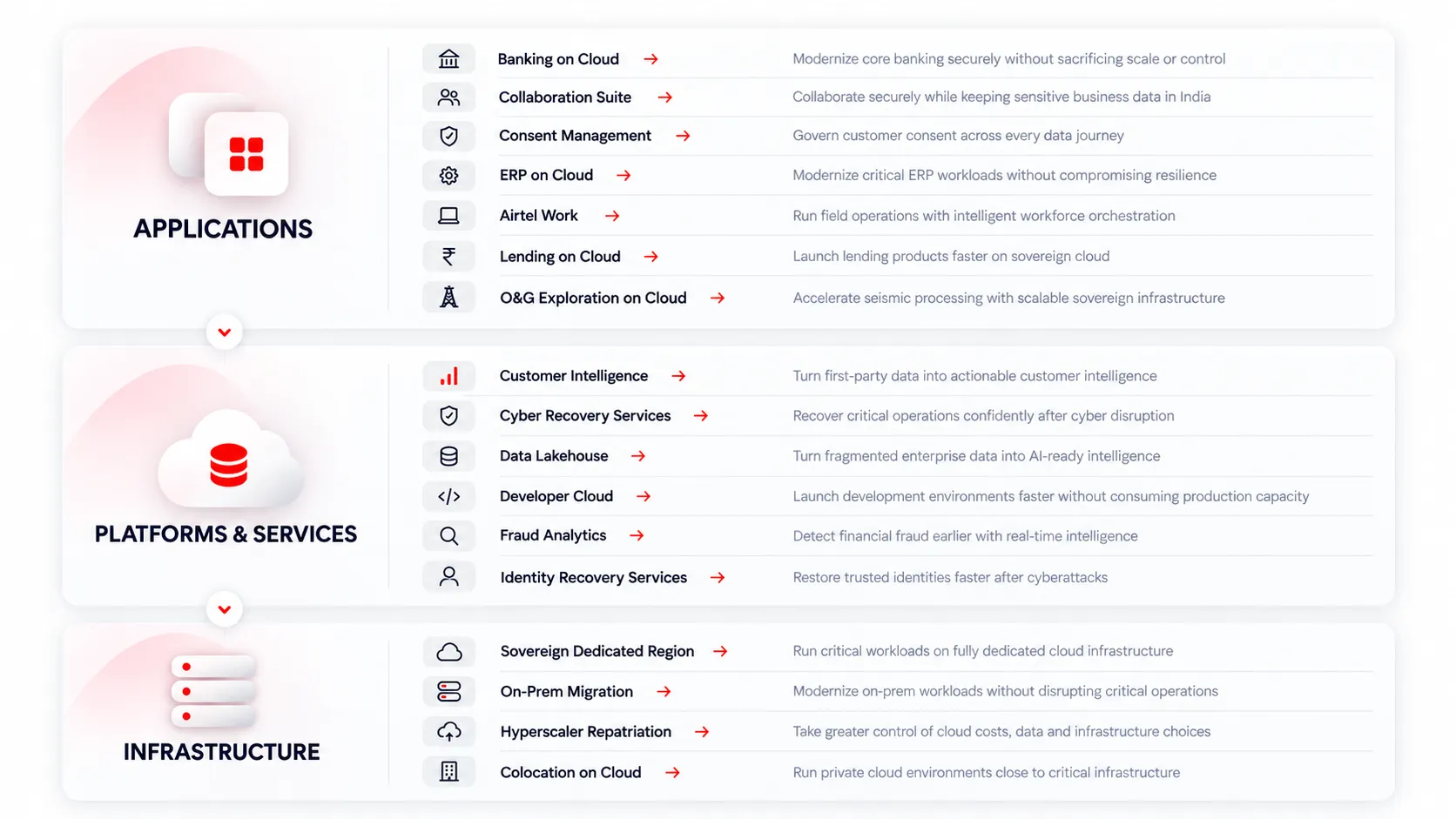
From Infrastructure to Platforms and Services to Applications, sovereignty throughout

Built with leading global OEMs to deliver high performance, scalability, and security by design.

Control extends across data, operations, technology, and jurisdiction — not just data residency

Built on Airtel’s own data centers with 99.95% uptime and high availability

Hosted entirely in India with full data and metadata residency, ensuring compliance

Minimal data egress charges, with flexible and transparent pricing to maximize cloud value.

Securely move petabytes of offline data to cloud without disrupting processing, even in tough network conditions.

Data, at rest and in transit, in India.

Control planes, security, and every update from India

Every operation and every escalation overseen in India

Every dispute governed by Indian law
Moving our infrastructure to Airtel Cloud has helped us modernize ageing systems and reduce the operational burden of managing on-premises technology. With integrated compute, databases, storage, backup, disaster recovery, and security, we have achieved lower TCO, 99.99% uptime, DPDP compliance, and significantly greater scalability.




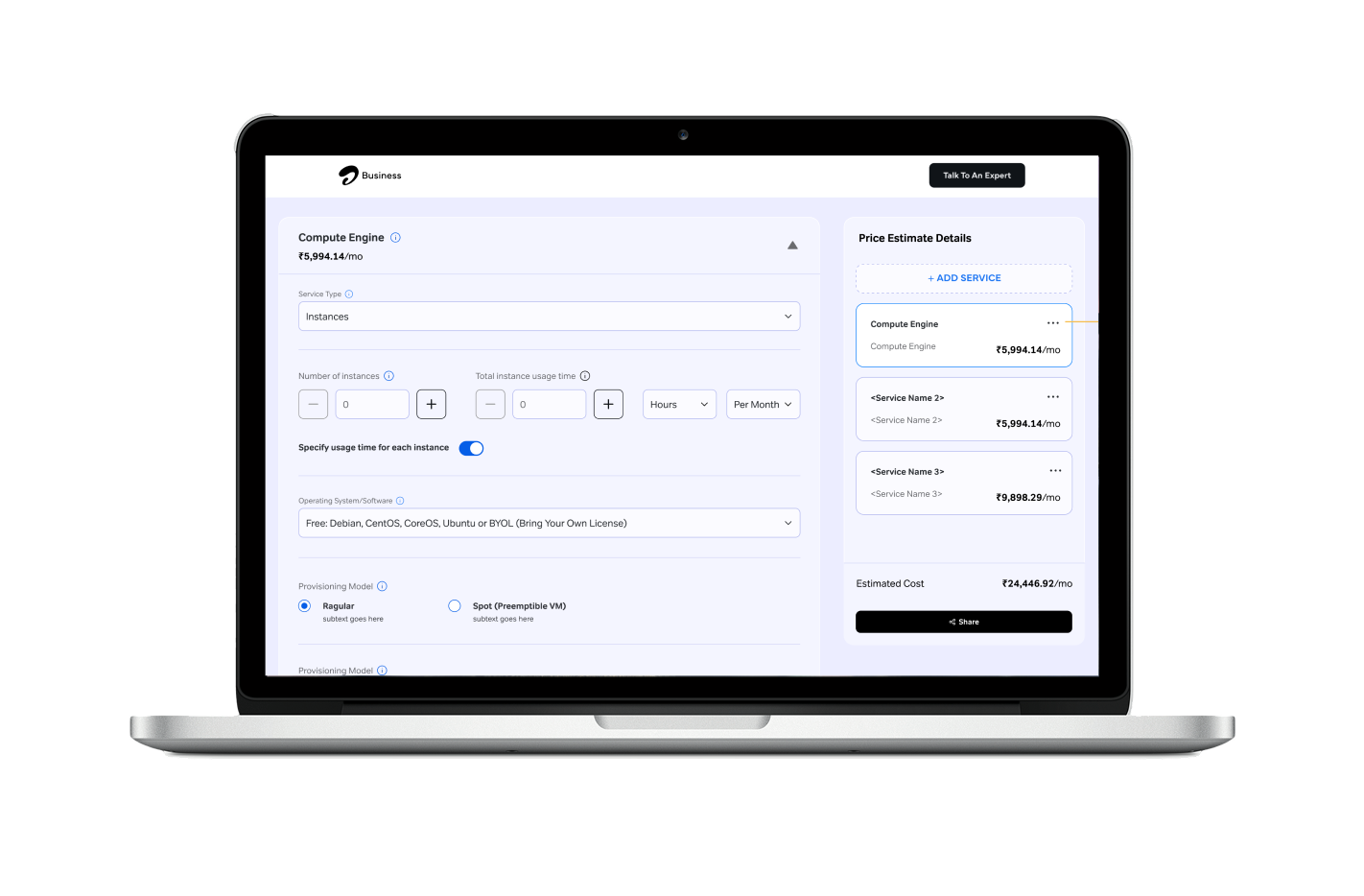
Estimate monthly cloud costs instantly - choose services, input quantities, and get transparent pricing across workloads, in real-time.

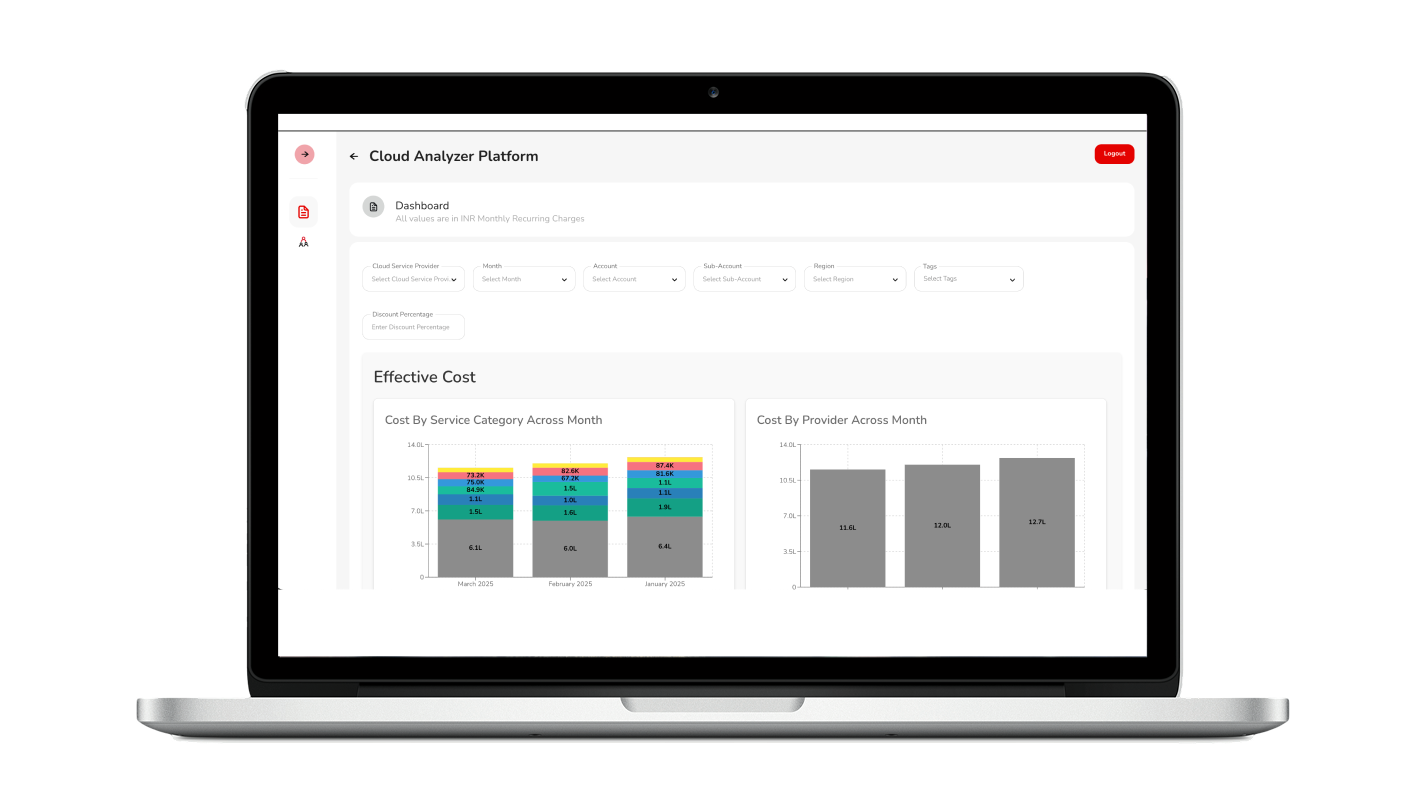
Easily track, analyze, and optimize your cloud spends with detailed insights and clear competitor comparisons, free of cost.
A structured decision-making framework to choose the right cloud platform based on business needs, workloads, and compliance requirements.
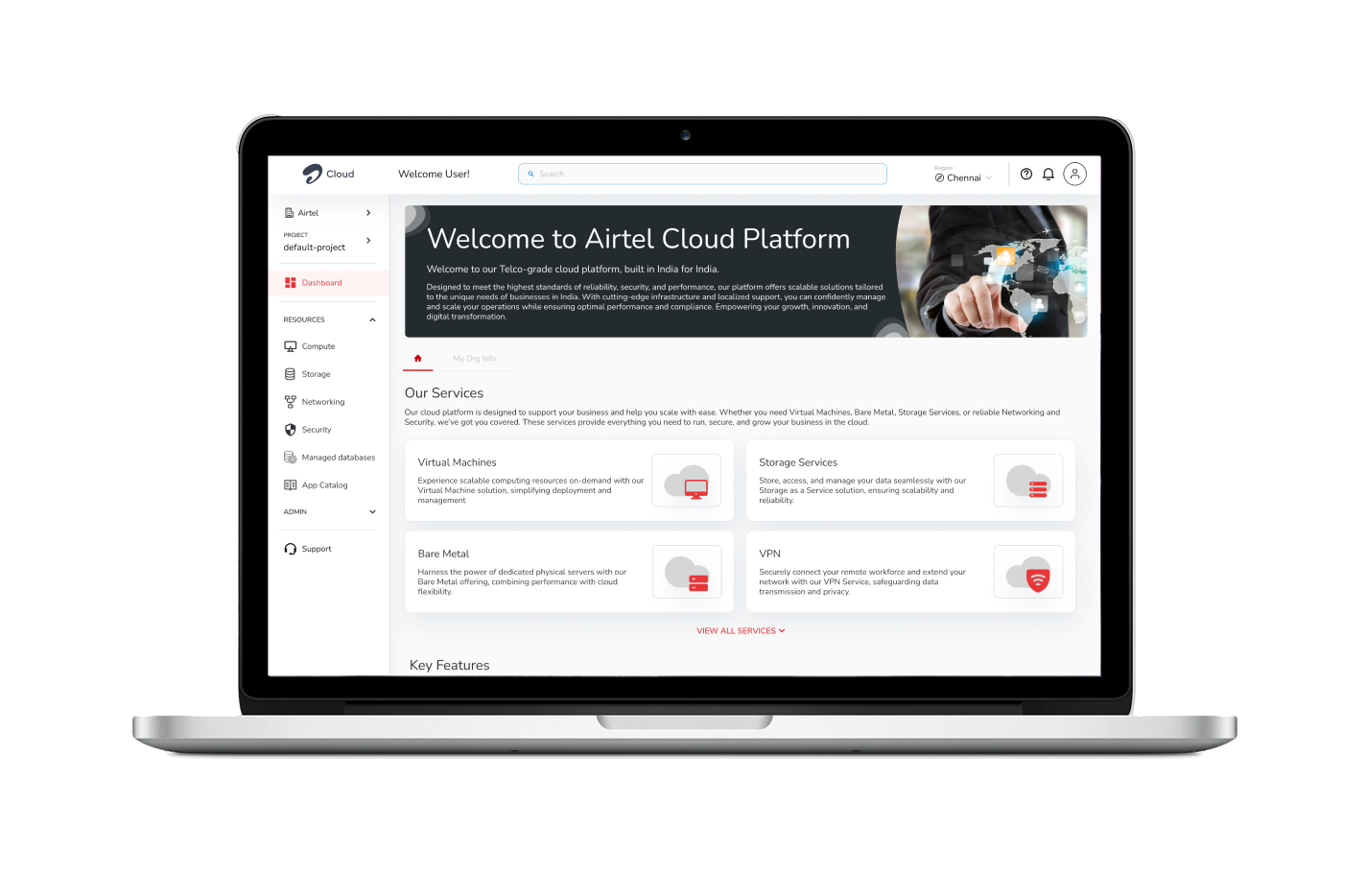
Gain centralized control to manage, optimize, and govern cloud resources for your organization.
Access comprehensive Airtel Cloud documentation to deploy, manage, and optimize your cloud environment with confidence. Explore product guides, API references, tutorials, and best practices in one place.
Explore perspectives, trends and practical guidance on the evolving enterprise cloud landscape.

Dive deeper into cloud sovereignty, architecture, modernization and emerging enterprise technology priorities.
See how enterprises are using Airtel Cloud to modernize workloads, improve resilience and create measurable business outcomes
Access comprehensive Airtel Cloud documentation to deploy, manage, and optimize your cloud environment with confidence. Explore product guides, API references, tutorials, and best practices in one place.
Airtel Cloud is India’s first telco-grade public cloud platform built by Xtelify, Airtel’s digital subsidiary. It handles 1.4 billion transactions per minute, originally powering Airtel’s own operations across India. The platform offers Infrastructure-as-a-Service (IaaS) and Platform-as-a-Service (PaaS) with virtual machines, bare-metal servers, and Gen AI-powered provisioning. Built on sustainable data centers with 99.99% uptime, it guarantees complete data sovereignty with all data and metadata residing within India. The service promises 40% lower costs compared to global cloud providers.
Airtel Cloud holds multiple security certifications including ISO27001, SOC1, SOC2, CMM 3.0 BCMP, and ITIL. Security operations are managed by professionals certified in CISSP and CISM standards. The platform features end-to-end encryption, telco-grade network isolation, and role-based access controls. With over 20 years of cybersecurity experience, Airtel is an empanelled cybersecurity partner with the Indian Computer Emergency Response Team. All data remains within India’s borders, ensuring regulatory compliance for sensitive workloads across banking, government, and enterprise sectors.
Airtel Cloud demonstrates maturity through its operational scale and strategic partnerships. The platform already powers all internal Airtel applications and supports operations for Singtel, Globe Telecom, and Airtel Africa. Scheduled for full commercial launch in June 2025, it expands Airtel’s cloud availability zones from 4 to 10 across India. Built on Airtel’s experience running one of India’s largest private cloud infrastructures, it addresses 590 million customer touchpoints daily. The telco-grade platform meets stringent regulatory compliance, data sovereignty, and reliability requirements for enterprise workloads.
While specific documentation portals aren’t publicly detailed yet, Airtel Cloud provides comprehensive support infrastructure. The platform offers 24×7 cloud management through 500+ certified experts following ITIL processes. Users access centralised control panels for resource management, optimisation, and governance. A Gen AI voice bot enables quick resource setup with minimal clicks. The unified customer portal provides visibility of security metrics and KPIs. Support covers the complete service lifecycle from conceptualisation and planning through implementation to ongoing operations, all managed under single SLAs.
Airtel Cloud includes a complimentary self-serve tool providing insights into cloud spending across different platforms. The service features bundled flat and integrated pricing structures for predictable total cost of ownership (TCO). Unlike hyperscalers charging hefty data egress fees, Airtel Cloud minimises these charges. Businesses benefit from transparent pricing models without hidden costs. The platform promises up to 40% cost reduction compared to global providers. This pay-as-you-go model eliminates capital expenditure, letting businesses pay only for consumed resources while avoiding vendor lock-ins completely.
Telco-grade reliability means 99.999% uptime—just 5.26 minutes of downtime yearly. This standard requires infrastructure robustness beyond typical enterprise clouds, supporting carrier-grade workloads at massive scale. Airtel Cloud achieves this through built-in redundancy, failover mechanisms, and round-the-clock monitoring. The platform connects through Airtel’s tier-1, 5G-ready network spanning 100+ data centers across India. Multiple redundant paths ensure business continuity. Originally built to handle Airtel’s own mission-critical operations processing 1.4 billion transactions per minute, it brings telecommunications-level dependability to enterprise cloud services.
BFSI enterprises face strict RBI, IRDAI, and SEBI regulations requiring complete data residency within India. Airtel Cloud ensures full compliance with PCI-DSS standards mandatory for Indian banks protecting cardholder data. All data and control planes remain India-hosted, unlike foreign clouds storing metadata overseas. The platform provides comprehensive audit trails, compliance reporting, and role-based access controls. With ISO27001 and SOC certifications mapped to RBI frameworks, it addresses regulatory requirements while enabling digital transformation. Financial institutions gain sovereign cloud infrastructure without compromising security or regulatory adherence.
E-commerce platforms experience massive traffic spikes during sales events, with Amazon India recording 18,000 orders per minute during Prime Day 2025. Airtel Cloud’s auto-scaling capabilities instantly adjust computing resources to handle surges. Virtual machines launch in under 60 seconds, enabling rapid capacity expansion. During off-peak periods, businesses scale down to save costs. The pay-per-use model means paying only for consumed resources. With 10 availability zones across India ensuring low latency, e-commerce sites maintain performance even during flash sales and festive shopping seasons.
Enterprises eliminate upfront hardware investments and ongoing maintenance costs by adopting public cloud. Airtel Cloud reduces TCO by up to 40% compared to global providers through minimal egress charges and transparent pricing. Businesses convert capital expenditure to operational expenditure, improving cash flow. The integrated cloud-plus-connectivity approach eliminates multi-vendor overhead. Automated resource optimisation tools prevent overprovisioning. Companies avoid costs of data center space, power, cooling, and IT staff for infrastructure management. Pay-as-you-go pricing means paying only for actual usage, not idle capacity sitting unused in private data centers.
Public clouds share infrastructure among multiple customers, offering economies of scale and pay-per-use pricing. Private clouds dedicate infrastructure to single organisations, providing exclusive control but requiring substantial capital investment. Public clouds like Airtel Cloud deliver instant scalability—spinning up resources in seconds versus weeks for private infrastructure procurement. While private clouds suit organisations needing complete infrastructure control, public clouds excel at cost efficiency, automatic updates, and maintenance-free operations. Airtel Cloud combines public cloud benefits with telco-grade security and Indian data sovereignty, bridging both models’ advantages effectively.
BFSI organisations leverage cloud for digital banking while maintaining regulatory compliance. E-commerce businesses handle traffic spikes during sales events without infrastructure investment. Media companies stream content globally using CDN integration. Healthcare providers store patient records securely with data sovereignty. Government departments like India’s DIKSHA education platform already run on Airtel Cloud. Manufacturing firms connect IoT devices for monitoring production lines. Startups avoid capital expenditure while scaling rapidly. Any industry needing flexible computing, storage, or platform services benefits from public cloud’s agility, especially those with variable workloads or compliance requirements.
Public cloud eliminates hardware procurement delays—deploy servers in under 60 seconds versus weeks. Businesses convert CapEx to OpEx, preserving capital for core operations. Automatic scaling handles demand fluctuations without manual intervention. Built-in disaster recovery across multiple data centers ensures business continuity. Regular platform updates provide latest features without downtime. Pay-per-use pricing prevents paying for idle resources. Professional management by certified experts reduces IT burden. Integration with connectivity services simplifies architecture. Businesses focus on applications rather than infrastructure maintenance, accelerating time-to-market for new services while reducing operational complexity significantly.
Modern public clouds invest heavily in security infrastructure exceeding most private data centers. Airtel Cloud exemplifies this with ISO27001, SOC1, SOC2 certifications and 24×7 monitoring by CISSP-certified professionals. Multi-layered security includes network isolation, encryption at rest and in transit, role-based access controls, and regular security audits. Public clouds benefit from economies of scale, employing dedicated security teams and advanced threat detection systems individual companies cannot afford. Shared responsibility models clarify provider versus customer obligations. With proper configuration, public clouds match or exceed private infrastructure security levels comprehensively.
Airtel brings 20+ years of cybersecurity excellence and telecommunications expertise to cloud services. As India’s leading connectivity provider, it operates nationwide infrastructure spanning 100+ data centers. The company’s cloud already handles 1.4 billion transactions per minute for internal operations, proving scale and reliability. Government partnerships include powering India’s DIKSHA education platform. Being Indian-owned ensures complete data sovereignty unlike foreign providers. Integration with Airtel’s connectivity services creates unique synergies. With 300+ certified cloud professionals and telco-grade infrastructure, Airtel combines local presence, proven expertise, and regulatory understanding perfectly.
Airtel Cloud hosts all data and metadata exclusively within Indian borders, meeting stringent regulatory requirements. Unlike global providers potentially storing control planes overseas, Airtel maintains complete infrastructure sovereignty. The platform adheres to RBI, IRDAI, SEBI frameworks for financial services, PCI-DSS for payment security, and government data localisation mandates. Comprehensive audit trails and compliance reporting simplify regulatory submissions. Indian ownership eliminates concerns about foreign government data access. Built specifically for Indian compliance needs, it addresses data residency requirements that challenge businesses using international clouds while ensuring seamless regulatory adherence.
Airtel Cloud provides PaaS modules and infrastructure optimised for compute-intensive workloads. The platform includes AI tooling through strategic partnerships, offering both virtual machines and bare-metal servers for training models. High-performance Intel servers handle complex calculations without virtualisation overhead. Gen AI integration powers the platform’s own voice-based provisioning system. Scalable infrastructure supports parallel processing requirements of machine learning algorithms. Integration with Google Cloud expands AI capabilities further. Businesses deploy AI applications without investing in expensive GPU infrastructure, accessing resources on-demand while benefiting from Airtel’s low-latency network for data transfer needs.
SMBs benefit significantly from Airtel Cloud’s pay-as-you-go model, avoiding large capital investments in IT infrastructure. The platform’s rapid deployment—launching VMs in under 60 seconds—suits agile business needs. Transparent pricing without hidden fees helps smaller companies budget effectively. Managed services by certified professionals reduce need for in-house IT teams. Starting small and scaling with growth prevents overinvestment. The self-serve pricing tool helps SMBs understand costs upfront. Integration with Airtel’s connectivity services simplifies procurement. Without minimum commitments or vendor lock-ins, small businesses access enterprise-grade infrastructure previously affordable only to large corporations.
Enterprises save up to 40% compared to global cloud providers through Airtel’s competitive pricing. Minimal data egress charges significantly reduce bills for data-intensive applications. Bundled cloud-plus-connectivity packages eliminate multi-vendor margins. The complimentary cost optimisation tool identifies savings across cloud deployments. Converting CapEx to OpEx improves cash flow and financial flexibility. Businesses avoid hidden costs like cross-region data transfer fees common with international providers. Single-vendor approach reduces procurement complexity and support costs. Indian data residency eliminates expensive compliance workarounds. Transparent, predictable pricing models help accurate budget planning without surprise charges affecting profitability margins.
Airtel provides comprehensive managed services covering the entire cloud lifecycle post-migration. Round-the-clock support from 300+ certified professionals ensures smooth operations. The unified management portal offers centralised control for resource optimisation and governance. Regular reviews identify cost-saving opportunities and performance improvements. ITIL-based processes ensure consistent service delivery. Single SLA covers both cloud and connectivity, simplifying vendor management. Automated monitoring prevents issues before they impact business. The support team assists with scaling, security updates, and compliance requirements. Unlike providers offering just infrastructure, Airtel’s end-to-end approach includes ongoing consultation, ensuring successful cloud outcomes.
Businesses start by consulting Airtel’s cloud experts for workload assessment and migration planning. The team analyses existing infrastructure, compliance needs, and performance requirements. Free cost calculator tools estimate savings and TCO benefits. Proof-of-concept deployments validate solutions before full migration. DataMover tools enable seamless data transfer from current systems. The Gen AI voice interface simplifies initial resource provisioning. Phased migration approaches minimise business disruption. Training ensures teams understand platform capabilities. With flexible contracts avoiding lock-ins, businesses test services risk-free. Expert guidance throughout ensures smooth transition from legacy infrastructure to modern cloud operations efficiently.

Seamless, high-performance content delivery with 100% uptime SLA
Learn More
Learn more about CDN