
Embedding Sustainability
Bharti Airtel strongly believes that power of communication can bring in multi-dimensional transformations, ensuring smooth functioning of life and businesses, and helping society to become sustainable and inclusive. Hence, Airtel devoted its core competence, technological solutions and innovations to “enriching lives” by catering to the emerging needs of millions in countries like Asia and Africa.
Back in year 2011, Airtel made social inclusion as the cornerstone of our sustainability programme to ensure that more and more people get included in the benefits of a sustainable and enriched life. Today, a comprehensive and structured ‘Sustainability Plan’ is in place that defines our corporate citizenship and how we aspire to act in the world. It is our endeavor to use our business for the larger good, and catalyze change in the community so that everyone we touch can endure and thrive.
At Airtel, we maintain regular and meaningful dialogue with our stakeholders to better understand their changing expectations, manage risks and seize new opportunities. These interactions help us stay responsive and informed. We have a robust stakeholder engagement framework which outlines a structured approach for communicating, partnering and collaborating with various stakeholders. The framework is embedded across multiple functions to ensure consistent, effective and coordinated engagement.
The primary focus of our framework is to:
- Facilitate our ability to understand stakeholder concerns and interests and incorporate them into processes and activities.
- Strengthen stakeholder engagement by enhancing clarity, accessibility, relevance and timeliness.
- Continue enhancing stakeholders’ trust and confidence in our processes, decisions and activities.
Stakeholder's expectations
Customers
- Network quality, expansion and transformation
- Innovation of products and services
- Information security and customer data privacy
- Enhancing customer experience and satisfaction
- Resource efficiency and waste management
- Fair marketing and advertising
Investors
- Corporate governance and business ethics
- Climate change, energy efficiency and emission reduction
- Innovation of products and services
- Regulatory compliance
Suppliers
- Sustainable supply chain management
- Green ICT solutions
- Innovation of products and services
- Promoting human rights
- Regulatory compliance
Employees
- Employee health and well-being
- Talent attraction and human capital development
- Diversity and inclusion
- Innovation of products and services
- Promoting human rights
Channel Partners
- Sustainable supply chain management
- Network quality, expansion and transformation
- Enhancing customer experience and satisfaction
Network Partners
- Network quality, expansion and transformation
- Climate change, energy efficiency and emission reduction
- Sustainable supply chain management
Regulatory Bodies
- Corporate governance, business and ethics
- Regulatory compliance
- Information security and customer data privacy
Communities
- Corporate citizenship and community development
- Regulatory compliance
- Digital inclusion and enhanced access to ICT
We are committed to a robust, stakeholder-led materiality assessment that keeps our ESG priorities relevant, evidence-based and action-oriented. We engage with a broad spectrum of stakeholder groups to finalise our materiality matrix ensuring it reflects their key concerns and priority areas.
How is materiality assessed at Airtel?
We review our materiality assessment every three years to ensure a thorough understanding of factors that could significantly impact our long-term value creation. We reviewed our materiality assessment in the previous year to determine and prioritise key sustainability topics relevant to our business and stakeholders. We engage with internal and external stakeholders to understand the issues that impact them and are influential on our business performance and value creation. A comprehensive assessment was carried out in line with GRI Standards, ISO 26000 and guided by the AA1000 Accountability Principles.
Material Topics
Material topics highlight the areas that matter most to our stakeholders and have a meaningful impact on our business outcomes. They are dynamic in nature and may evolve over time in response to changes in the external environment and emerging stakeholder expectations. Our material topics undergo a structured prioritisation process and are then reviewed by senior management, followed by approval from the Board ESG Committee. These topics are presented in a materiality matrix, categorising them as critical, high, or moderate based on their significance to the business and stakeholders.
- Information security and customer data privacy
- Talent attraction and human capital development
- Corporate governance and business ethics
- Climate change, energy efficiency and emission reduction
- Enhancing customer experience and satisfaction
- Network quality, expansion, and transformation
- Regulatory compliance
- Innovation in product and services
- Employee health and well-being
- Diversity and inclusion
- Sustainable supply chain management
- Promoting human rights
- Corporate citizenship and community development
- Resource efficiency and waste management
- Fair marketing and advertising
- Digital inclusion and enhanced access to ICT
- Water efficiency
- Green ICT solutions
Airtel ensures compliance to the highest standards of corporate governance through numerous policies, guidelines and standards. The company adheres to the highest levels of ethical and transparent business practices as articulated by the "Bharti Code of Conduct" which covers ethics, bribery, corruption and human rights. This is applicable to employees, suppliers and contractors, service providers, channel partners and their employees.
To facilitate an effective implementation of our Code of Conduct, we have an Ombudsman process which allows employee, contractors and vendors, to raise a grievance or complaint without any fear of reprisal. A formal process is undertaken to review and investigate any concern and take appropriate action in accordance with the Consequence Management Policy. All employees have to annually reaffirm their compliance to the code of conduct, and this compliance is strictly monitored. The Audit Committee oversees the overall functioning of Code of Conduct and Ethics framework, and the ethics issues/ instances of misconduct, if any, are periodically reported to the Audit Committee.
Internal Audits are undertaken every year to assess the design and operating effectiveness of the Code of Conduct of the Company, including the ethics framework covering anti-bribery and anti-corruption across all the business operations. Any finding(s) noted as part of the internal audits, is reported to Audit Committee.
Other Airtel policies have evolved in order to effectively engage with our stakeholders to maximize positive impact on environment and society. To ensure the health and safety of the community at large, Airtel also ensures that it is aligned with national and international guidelines on EMF.
Airtel believes that risk management and internal control are fundamental to effective corporate governance and the development of a sustainable business. It has a robust process to identify key risks across the group and prioritize relevant action plans that can mitigate these risks.
The Airtel brand essence of enriching lives embeds sustainability into its mainstream business agenda. A robust system of governance is in place and stakeholders help derive material issues that shape our ESG strategy and programs.
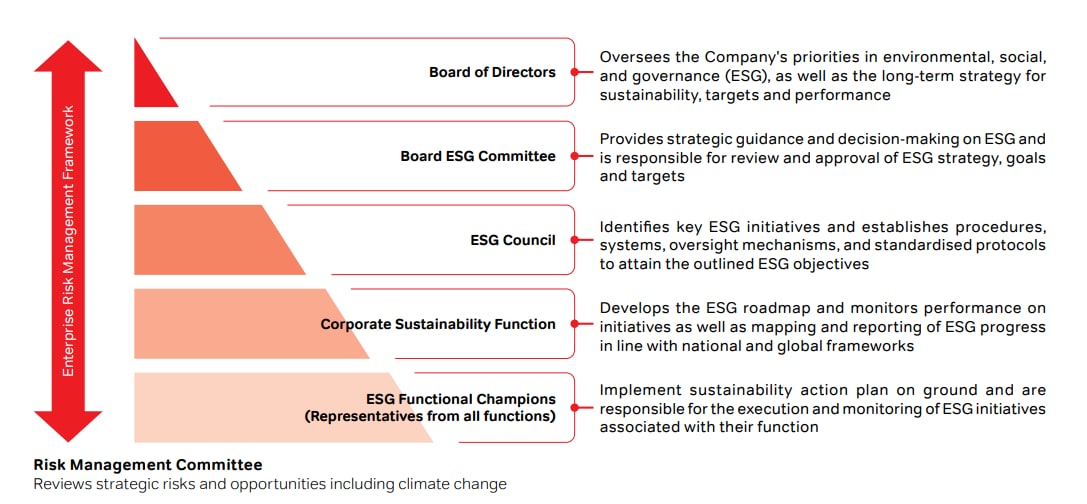
ESG Governance Structure
The Board of Directors(‘the Board’) oversees the Company's priorities in environmental, social, and governance (ESG), as well as the long-term strategy for sustainability, targets and performance.
Board ESG Committee of the Board provides strategic guidance and decision-making on ESG and is responsible for review and approval of ESG strategy, goals and targets.
ESG Council (at Management level) identifies key ESG initiatives and establishes procedures, systems, oversight mechanisms, and standardised protocols to attain the outlined ESG objectives.
Corporate Sustainability Function develops the ESG roadmap and monitors performance on initiatives as well as mapping and reporting of ESG progress in line with national and global frameworks.
ESG Functional Champions (representative from all functions) implement sustainability action plan on ground and are responsible for the execution and monitoring of ESG initiatives associated with their function.
Risk Management Committee reviews strategic risks and opportunities including climate change.
| Description | View Files |
|---|---|
| Description
Bharti Airtel Supplier Safety Policy |
View File
|
| Description
Bharti Airtel POSH Policy |
View File
|
| Description
Bharti Airtel EHS Policy |
View File
|
| Description
Bharti Airtel Human Rights Policy |
View File
|
| Description
Bharti Airtel Tax Policy |
View File
|
| Description
Stakeholder Engagement Framework |
View File
|
| Description
Bharti COC Policy |
View File
|
| Description
Ombudsperson policy and process |
View File
|
| Description
Code of Conduct for Business Associates |
View File
|
| Description
Bharti Airtel CSR policy |
View File
|
| Description
Bharti Airtel Privacy Policy |
View File
|
| Description
Airtel Sustainable Procurement Policy |
View File
|

| SDG | Our Approach | Our Initiatives |
|---|---|---|
|
|
Airtel views any potential health and safety risk to its stakeholders very seriously and actively promotes the good health and well-being of its employees, business partners and the broader community. |
We provide a safe working environment to our employees, and take concrete measures to promote good health, such as through wellness drives, on-site doctor, health risk assessments, stress management trainings and gym facilities. Regular safety trainings are provided to employees in order to ensure avoidance of hazards. Cautious action is taken to ensure that our offices function as havens of efficiency and high workforce productivity, through maintaining an ergonomic design, optimum levels of indoor air quality, noise, temperature and humidity. Our office design facilitates comfort, convenience and collaboration among the employees, and is suitable to the needs of all. |
|
|
Airtel has adopted a significant role in enabling the progress, development and inclusion of the vulnerable sections of the community where it operates, through provision of quality education. We believe that education is the foundation for eradication of poverty, and hence view it as an essential component for fulfilling our corporate social responsibility. |
Bharti Airtel has committed itself towards sustainable development through actively engaging with the communities it operates in. Our philanthropic efforts, employee volunteerism, and local community outreach initiatives support the desire to be seen as a trusted partner - one that honours its commitments and takes pride in the role it plays in community wellness. It is determined to create a deep-rooted, positive impact on society at large. Therefore, it proactively applies its competence and partnerships to promote development initiatives through initiatives undertaken by Bharti Foundation, the philanthropic arm of Bharti Enterprises, and its own telecom circles at the regional level. |
|
|
Respecting diversity is one of the core values with which Airtel conducts itself. It not just respects but promotes diversity of gender, ethnicity, race and nationality, in order to build a truly inclusive organization. |
Airtel respects diversity and encourages the same through its culture. Female employees are well represented across all levels of the organization. We have dedicated programs that aim to empower women and promote gender equality. Gender sensitization workshops like ‘Inclusion in action’ and ‘Unconscious Bias’ is covered for all people managers to create an inclusive and gender neutral workplace culture. We have progressive policies for employees that enable a friendly and engaged work environment. We also have dedicated program for women employees like ‘We lead’ aiming to create women leaders of tomorrow by building on identified competencies. |
|
|
Airtel is committed to adopt clean energy and is in constant efforts to reduce its reliance on fossil fuels, increase its share of renewable energy, and thus reduce its ecological footprint. |
We are taking proactive steps to increase the share of renewables in our energy mix, in order to reduce our ecological footprint. From Installation of Rooftop solar panels and procurement of Green Energy through power wheeling arrangements. 322,119 MWh of energy consumed in our operations was from renewable sources. |
|
|
Airtel is committed to create the most conducive workplace for its employees to grow and develop, ensuring equal opportunity and ethical conduct. |
We employ around 27,730 people globally and have consciously adopted a policy of equal opportunity for all people related activities, be it recruitment, selection, career planning, or growth. Our network reaches to the remotest pockets of India, where the rural population suffers from poverty and lack of opportunities. Airtel takes special measures to employ the local youth at these sites and help them attain sustainable livelihoods. Through a sustainable supply chain management program, we ensure the adherence to human rights and labor laws amongst our vendors as well. |
|
|
Airtel is in continuous momentum to innovate and come up with new products and services, to give an enhanced experience to its customers, and find creative solutions to social problems. |
Innovation runs at the heart of Airtel. Leveraging latest technologies, strong R&D, and effective collaborations, Airtel comes up with innovative products and services each year to create an advanced way of living, for its customers. Some of our measures include. From enabling our customers through digitization and self-care, facilitating convenience through digital stores, we are striving to innovate in every aspect of our operations. Apart from telecom, we also provide innovative technology solutions to address the need for basic life services such as health, education, financial inclusion and agriculture.We are in a continual process to strengthen our infrastructure, i.e. network infrastructure, through modernization and expansion, in order to provide the best quality service. We also indulge in passive infrastructure sharing, in order to optimize resource consumption and reduce our environmental impact. |
|
|
Airtel is committed to promote diversity and inclusion, reduce inequalities by prohibiting discrimination and promote Human Capital Development. |
Airtel is committed to preventing any violation of human rights throughout our operations, supply chains, communities and business relationships. All employees receive training to ensure prevention of discrimination and harassment in the workplace. We have institutionalized policies to prohibit discrimination and foster culture of diversity and inclusion. We focus to enhance skills of individuals by promoting training and development. |
|
|
Airtel is committed to transition towards circular economy through reduction of waste and resource optimization at all stages of its operations. |
Airtel has declared War on Waste and is taking concrete steps to reduce our resource consumption and transition to a more sustainable production. Measures include recycling of paper and E-waste, introduction of E-bills, take back & refurbishing of DTH set top boxes, shift to green mobile tower technologies that consume less power, green network Infrastructure, tower sharing to save resources like steel, cement, concrete, zinc and land. We are also striving to increase the share of renewable energy in our total energy mix. |
|
|
Airtel is proactively contributing to the global climate change movement, through measurement and reduction of its ecological footprint across the value chain, including business operations, supply chain and delivery of services. |
Airtel understands its responsibility to consistently evaluate the impact of its services, operations and infrastructure on the environment. The Company acknowledges the need for constant assessment of its overall influence on energy consumption and greenhouse gas (GHG) emissions. We undertake a plethora of measures to increase our energy efficiency and reduce carbon emissions, such as installation of solar panels, alternating diesel battery hybrid mode which helps to reduce diesel consumption, green power wheeling agreement for procurement of green energy, switching off ACs and utilizing natural solar cooling to reduce energy demand at own & partner sites, intelligent shutdown technology which switches off equipment during non-peak hours, cold aisle containment that uses a physical barrier to reduce the mixing of cold air and hot exhaust air in data center aisles. |
|
|
Airtel is committed to a strong and robust foundation of ethics and responsibility to sustain economic value. |
Airtel, with its legacy of fair, transparent and ethical governance practices, the Company’s Code of Business Conduct reinforces its commitment to operate with the highest degree of integrity and is applicable to all employees, Board of Directors, subsidiaries, and Business Associates (suppliers, contractors, service providers and other key business partners) of the company. It outlines principles against discrimination, anti-competitive practices, insider trading and prohibits corruption, bribes, kickbacks, and improper payments. Further, to avoid any conflict of interest, the Company has placed necessary safeguards as part of its Corporate Governance structure and the Code of Conduct. To ensure effective implementation of its Code of Conduct, Airtel’s Ombudsman policy allows employees, contractors, and vendors to raise a complaint without any fear of reprisal. Further to promote an effective, accountable, and transparent institution based on inclusive decision making, Airtel has a sound corporate governance philosophy and structure in place. |
 Goal 3: Good Health & Well-being
 Goal 4: Quality
Education
Goal 4: Quality
Education Goal 5: Gender Equality
 Goal 7: Affordable &
Clean Energy
Goal 7: Affordable &
Clean Energy Goal 8: Decent Work
& Economic Growth
Goal 8: Decent Work
& Economic Growth Goal 9: Industry,
Innovation & Infrastructure
Goal 9: Industry,
Innovation & Infrastructure Goal 10: Reduced
Inequalities
Goal 10: Reduced
Inequalities Goal 12: Responsible
Consumption & Production
Goal 12: Responsible
Consumption & Production Goal 13: Climate Action
 Goal 16: Peace Justice
and Strong Institutions
Goal 16: Peace Justice
and Strong Institutions